Originally published November 12, 2026, at 22:40 (UTC+8). This is a guide to checking how a subgraph, indexer or data API handles chain reorganizations—not a report of a specific outage.
A blockchain reorganization, or reorg, can invalidate a transaction that an indexer has already processed. An API may therefore return a result that later disappears from the canonical chain.
Consider a hypothetical transfer from Alice to Bob. If the transfer is invalidated, deleting its transaction record is not enough. The indexer must also reverse changes it made to related entities, balances, total value locked (TVL) and aggregate statistics, then reprocess the canonical chain.
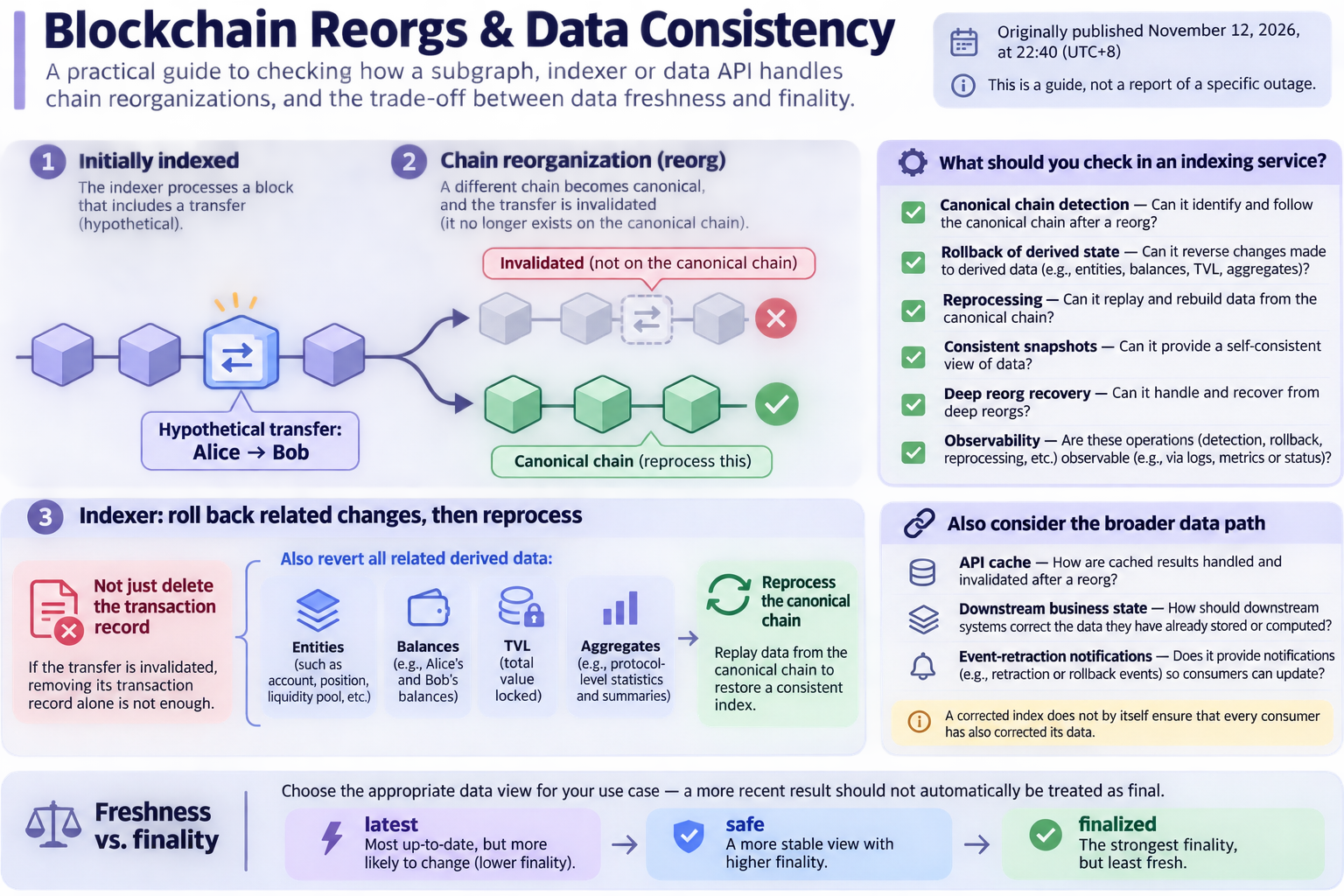
What should you check in an indexing service? Ask whether it can detect the canonical chain, roll back derived state, reprocess data, provide consistent snapshots, recover from deep reorgs and make those operations observable. Also check how its API caches, downstream business state and event-retraction notifications are handled: a corrected index does not by itself ensure every consumer has corrected its data.
Finally, decide whether your use case prioritizes fresh data or stronger finality. The source describes latest, safe and finalized as choices with different freshness–finality trade-offs; a recent result should not automatically be treated as final.
Source: learnblockchain.cn (originally published 2026-11-12 22:40 UTC+8)