In an analysis published on November 19, 2026, imToken examined a practical question behind Ethereum’s post-quantum plans: if today’s signature algorithms eventually become vulnerable, how can people keep control of their existing accounts and assets while changing keys?
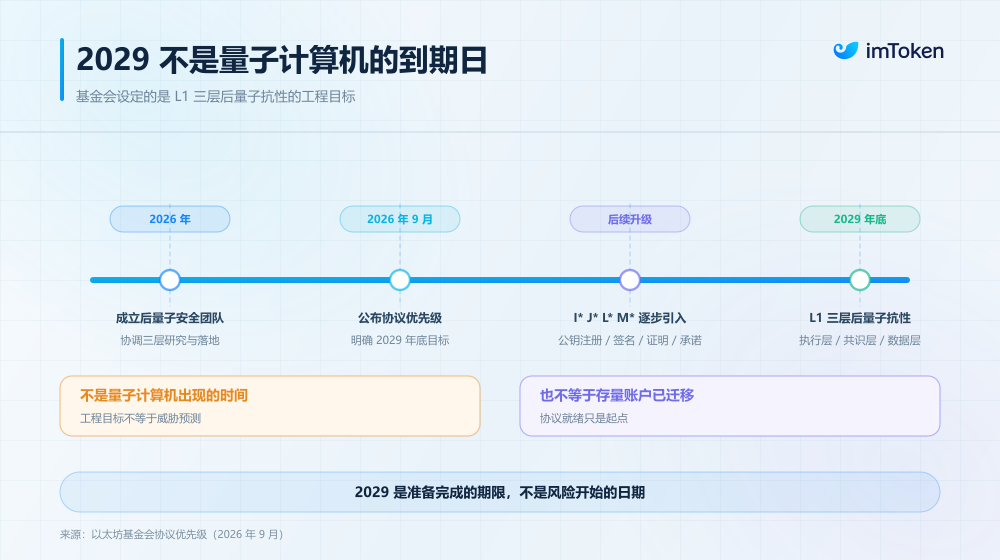
The analysis describes a target, not a completed upgrade. It says protocol priorities published in September 2026 aim to make Ethereum L1 post-quantum-resistant across its execution, consensus and data layers by December 2029.
Which parts of Ethereum are exposed?
Ordinary Ethereum accounts use ECDSA signatures; proof-of-stake validators use BLS signatures. Both rely on elliptic-curve cryptography. A sufficiently capable fault-tolerant quantum computer running Shor’s algorithm could, in theory, undermine the mathematical assumptions protecting their public keys. imToken also identifies validator keys, protocol multisignature permissions and bridge control keys as potential concerns.
Exposure differs between accounts. An ordinary Ethereum address is derived by hashing a public key. If an account has never sent an on-chain transaction or disclosed a signature off-chain, its full public key has not been revealed in the way described by the analysis. Once the account sends a transaction—including an approval—its public signature can reveal that key. This distinction does not mean an unused account has a permanent migration solution.
imToken says no quantum computer capable of breaking this cryptography existed at the time of its report. The concern is that changing a network’s cryptography and migrating accounts could take years; the analysis does not call for users to move assets in a panic.
What is being proposed?
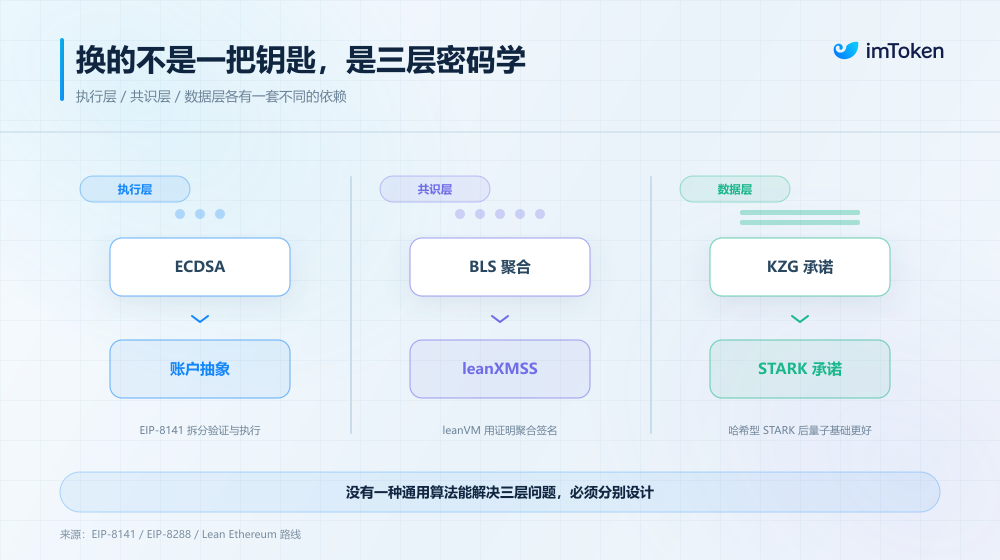
On the execution layer, imToken highlights native account abstraction, particularly EIP-8141, as a proposed way to separate transaction validation, execution and gas payment. Programmable validation could eventually let an account change its authorization method without necessarily changing its address. Post-quantum signature-verification precompiles are also under study. Because such signatures can be much larger than current ones, EIP-8288 proposes recursive STARK aggregation to reduce the data and verification burden.
On the consensus layer, the analysis describes leanXMSS as a proposed hash-based replacement for validator BLS signatures and leanVM as a proposed means of aggregating verification into compact proofs. These are engineering directions, not changes that the report says have already replaced Ethereum’s validator signatures.
The data layer presents a separate challenge: KZG commitments used with blobs and rollup data availability rely on elliptic-curve-related assumptions. Some pairing-based SNARKs used by applications may also be affected, while hash-based STARKs do not depend on the same elliptic-curve discrete-log assumption. That extends the migration question beyond L1 to rollups and other applications.
What would an account migration need to achieve?
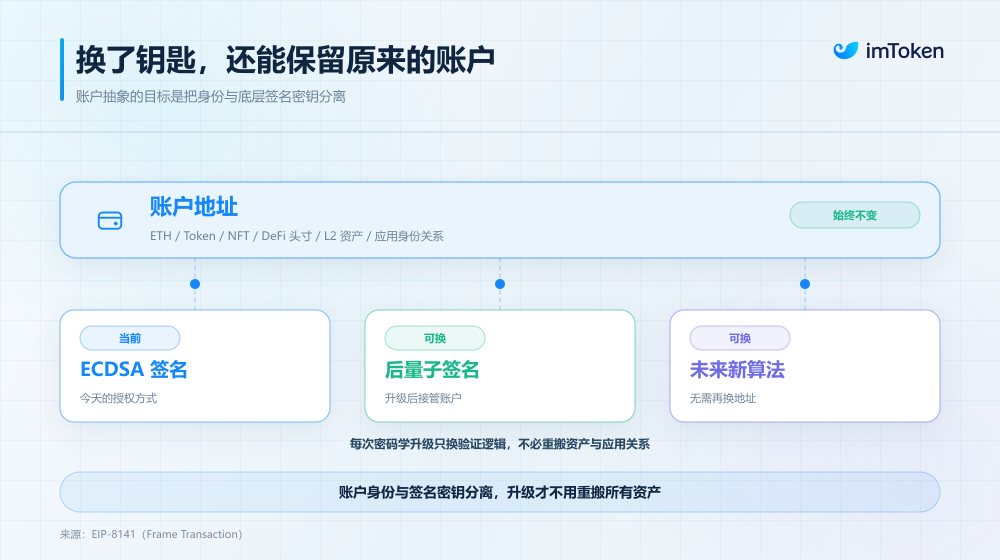
For a conventional externally owned account, switching to a different key system could mean a new address—and the need to deal with assets, DeFi positions and application relationships tied to the old one. imToken argues that programmable account validation could potentially allow a user to retain an account address while replacing its underlying authorization method. It does not present that as an available, tested wallet procedure.
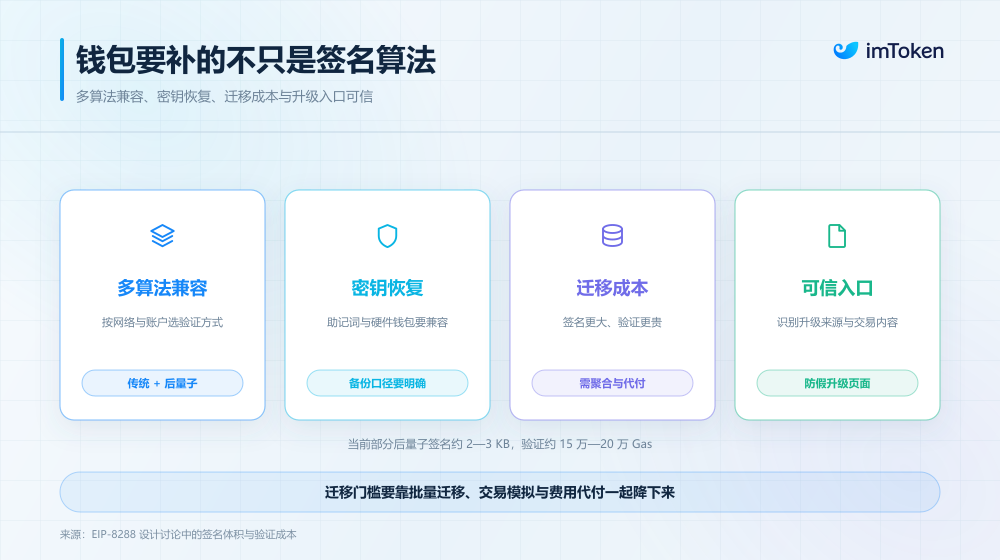
The conceptual sequence is to generate a new post-quantum key securely while the old key remains trustworthy, then use a valid authorization from the existing account to update its validation rules. If an attacker can already forge signatures from the old key, that authorization alone cannot reliably establish the rightful owner. Lost-key and inactive accounts pose another unresolved problem; imToken notes that possible responses, including freezing, remain contested.
For now, the actionable distinction is between preparing a verifiable migration process and responding to an unsolicited “quantum safety” prompt. The analysis warns that fake upgrade or migration pages could seek recovery phrases or malicious approvals. A real future workflow would need to let users verify where an upgrade comes from, what a transaction authorizes and which assets the new rules control.