In an article published on November 11, 2026, author ross.wei described Tacit Chain as a payment-focused zk-rollup prototype. Its proposed workflow combines private transfers, validity proofs checked on Ethereum and routes for moving assets between Ethereum, Tacit Chain and Bitcoin. The article’s performance and security claims are descriptions of the project, not independently verified results.
How a payment is meant to work
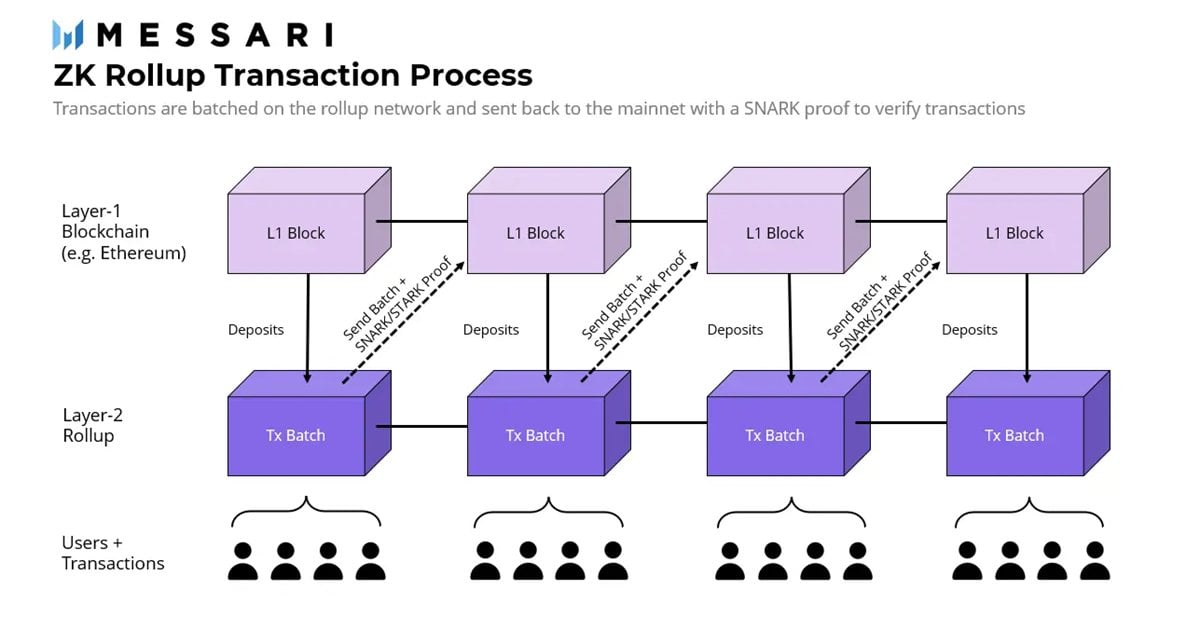
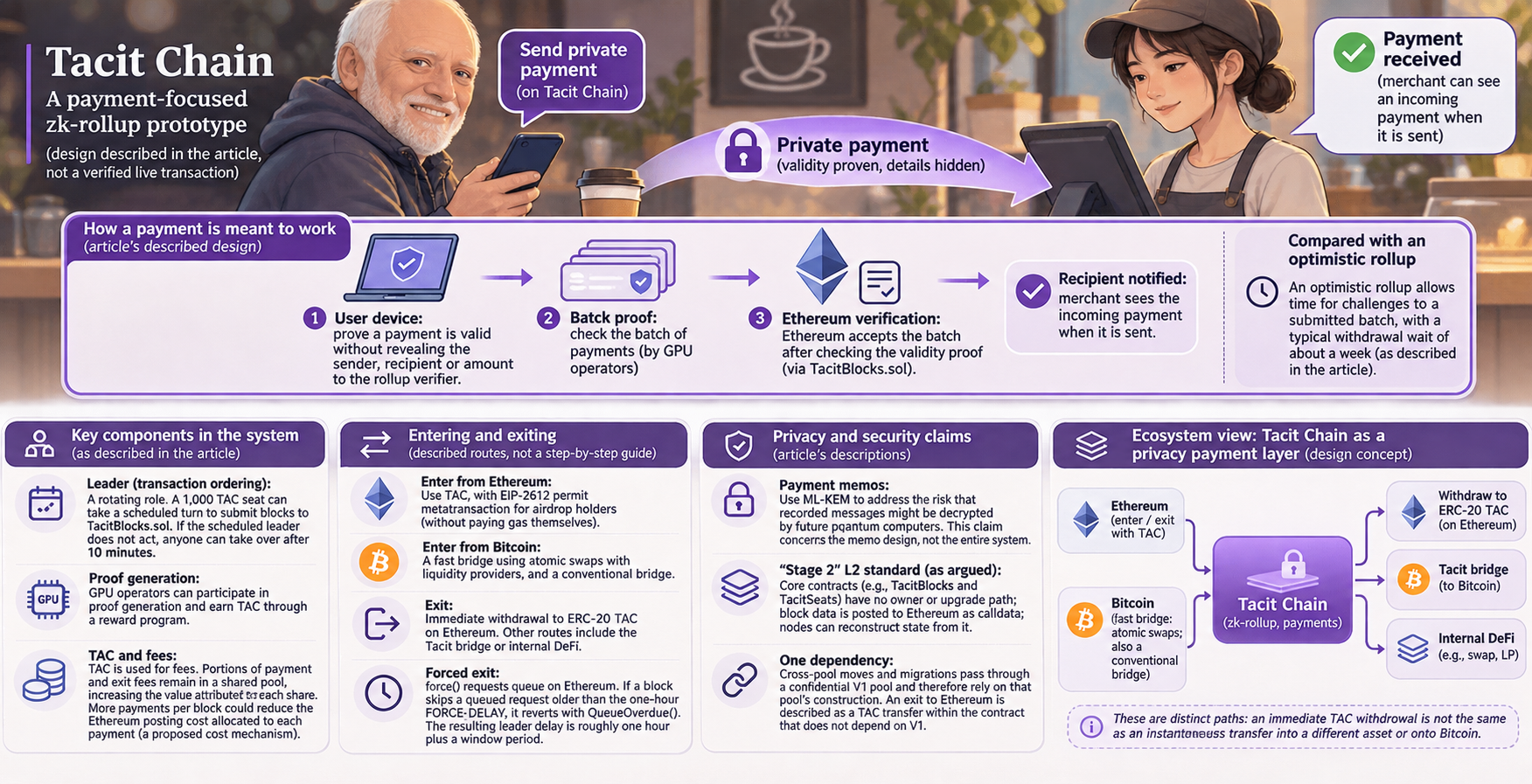
According to the author, a user’s device proves that a payment is valid without revealing the sender, recipient or amount to the rollup verifier. A second proof checks the batch of payments before Ethereum accepts it. This differs from an optimistic rollup, which allows time for challenges to a submitted batch; the article puts a typical optimistic-rollup withdrawal wait at about a week.

Tacit Chain calls its rotating transaction-ordering role a leader. A holder of a 1,000 TAC seat can take a scheduled turn submitting blocks to the Ethereum contract TacitBlocks.sol. If the scheduled leader does not act, the article says anyone can take over after 10 minutes. GPU operators can participate in proof generation and earn TAC through a reward program, according to the author.

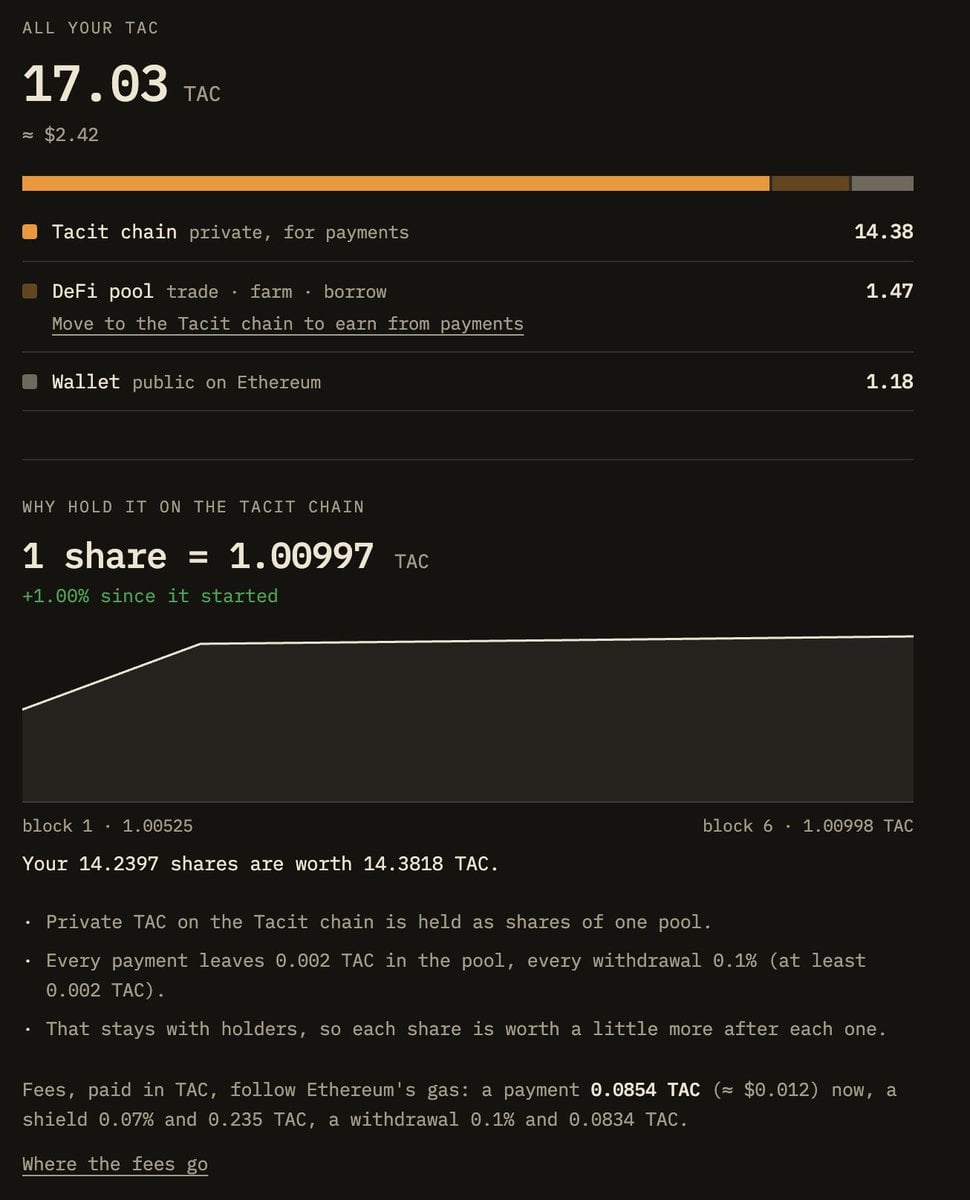
TAC is also used for fees. The article describes a share-based accounting system in which portions of payment and exit fees remain in a shared pool, increasing the value attributed to each share. It argues that more payments per block could reduce the Ethereum posting cost allocated to each payment; that is a proposed cost mechanism, not evidence of current usage or savings.
Entering, exiting and checking delays
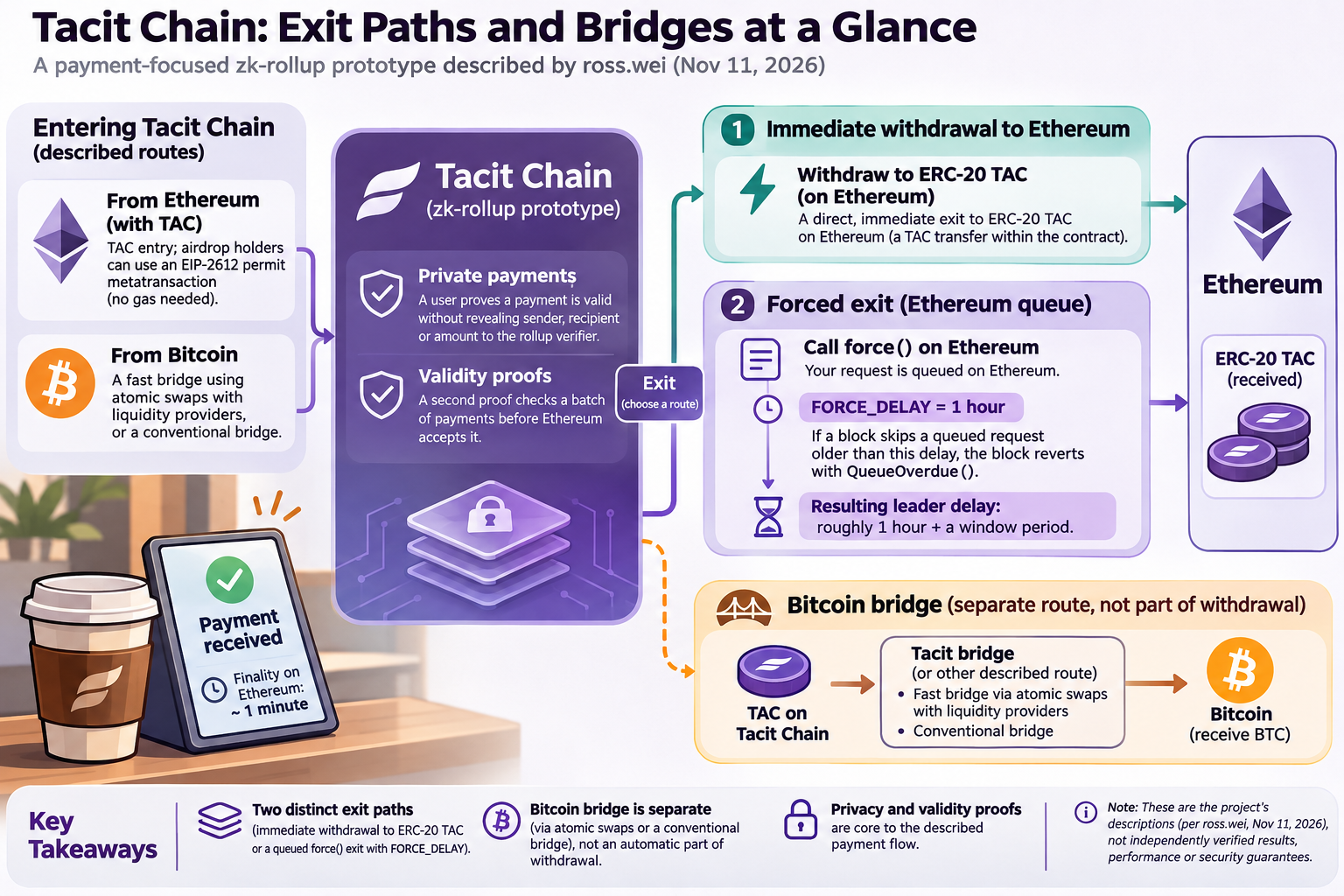
The described Ethereum entry route uses TAC. The article says holders of a TAC airdrop can enter through an EIP-2612 permit metatransaction without paying gas themselves; it does not provide a step-by-step wallet procedure. It also describes a Bitcoin fast bridge using atomic swaps with liquidity providers and a conventional bridge.
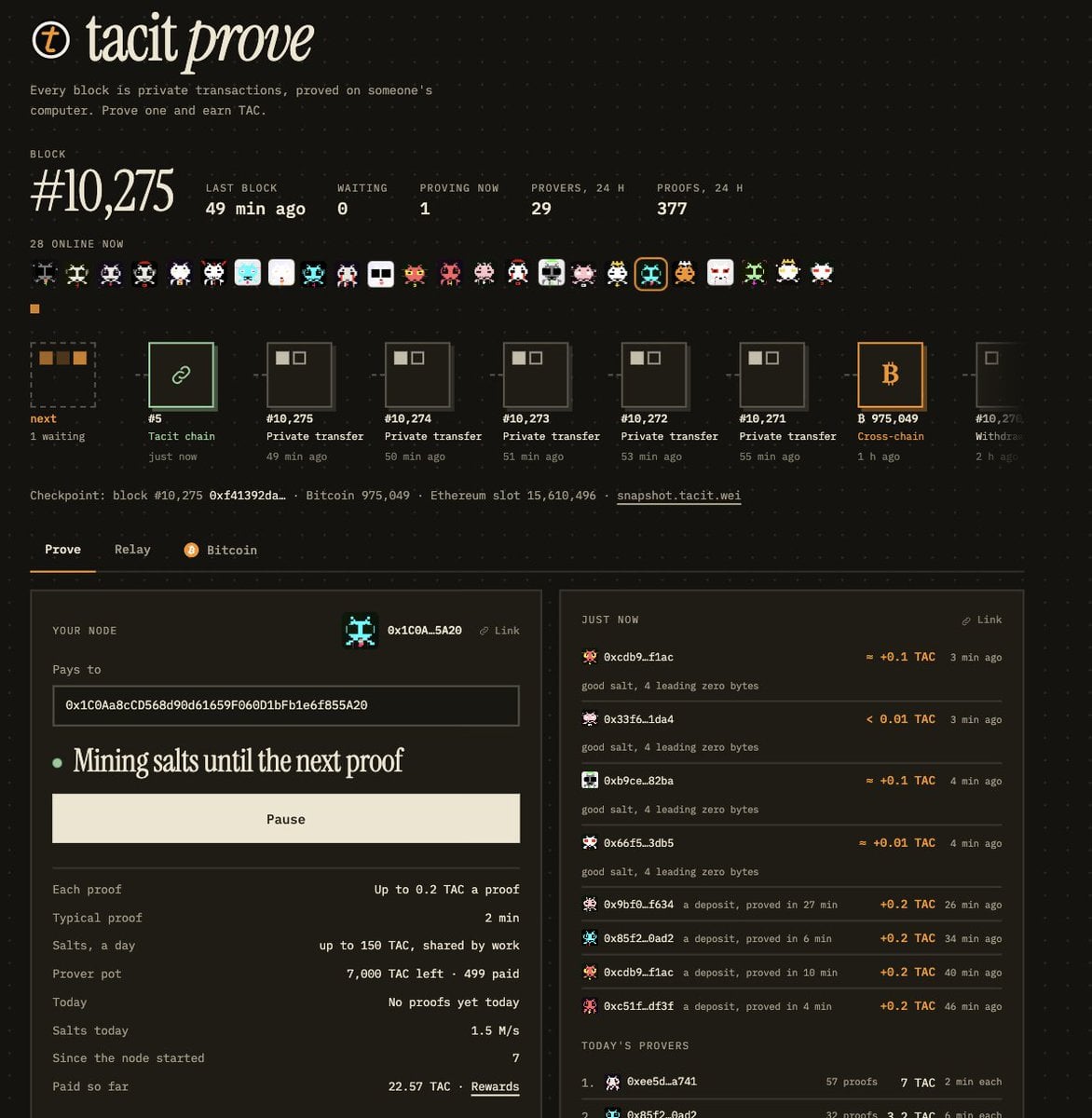
For exits, the author says users can withdraw immediately to ERC-20 TAC on Ethereum, with other described routes involving the Tacit bridge or internal DeFi. A separate forced-exit mechanism queues force() requests on Ethereum. Under the described rule, a block that skips a queued request older than the one-hour FORCE_DELAY reverts with QueueOverdue(). The author characterizes the resulting leader delay as roughly one hour plus a window period.
These are distinct paths: an immediate TAC withdrawal is not the same as an instantaneous transfer into a different asset or onto Bitcoin. The article does not supply instructions or measured completion times for each bridge route.
What the privacy and security claims cover
The author says payment memos—the encrypted information a recipient needs to identify a payment and its amount—use ML-KEM to address the risk that recorded messages might be decrypted by future quantum computers. That claim concerns the memo design; it does not establish that every part of the system is post-quantum secure.
The article argues that Tacit Chain meets a “Stage 2” L2 standard. As support, the author says core contracts including TacitBlocks and TacitSeats have no owner or upgrade path, block data is posted to Ethereum as calldata, and nodes can reconstruct state from it. The author identifies one dependency: cross-pool moves and migrations pass through a confidential V1 pool and therefore rely on that pool’s construction. An exit to Ethereum, by contrast, is described as a TAC transfer within the contract that does not depend on V1.
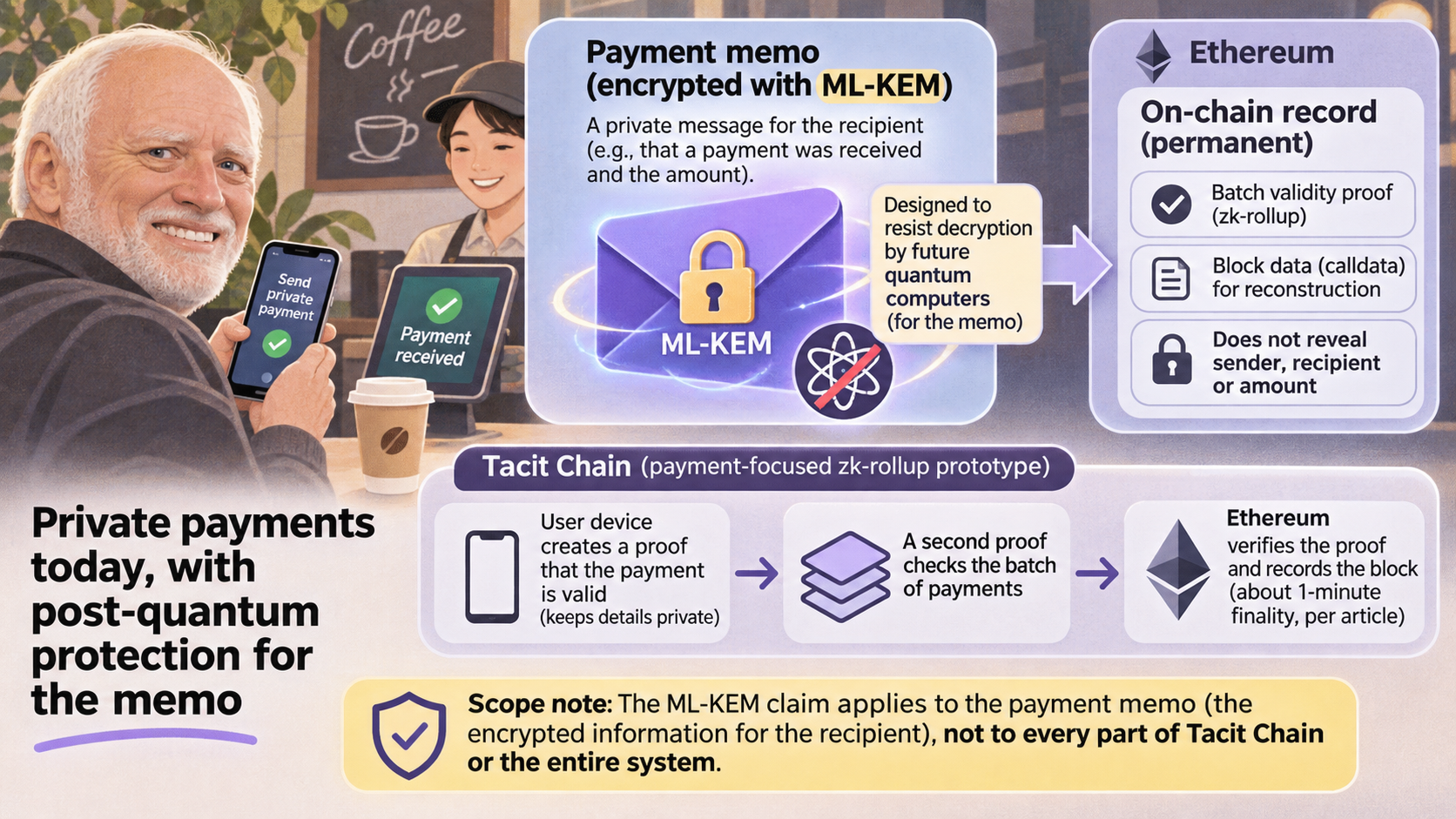
Finally, the author says a merchant can see an incoming payment when it is sent and that Ethereum finality takes about one minute. A possible move toward 30 seconds, costs below one cent using blobs, internal smart contracts and additional assets are presented as future expectations or directions—not established outcomes. The proposed migrate operation is described as opt-in.