A new token can begin trading before it has an order book or a conventional automated market maker (AMM) pool. A bonding curve supplies prices under preset contract rules; once specified conditions are met, the token can “graduate” to an AMM. The practical question is what happens to the assets, fee rights and liquidity providers (LPs) at that handoff.
In an analysis published on November 23, 2026, Go2Mars’s Web3 Research compared how Pump.fun, Meteora Dynamic Bonding Curve (DBC) and Raydium LaunchLab handle those stages. The comparison describes their mechanisms, not evidence that any one of them has achieved better long-term liquidity.
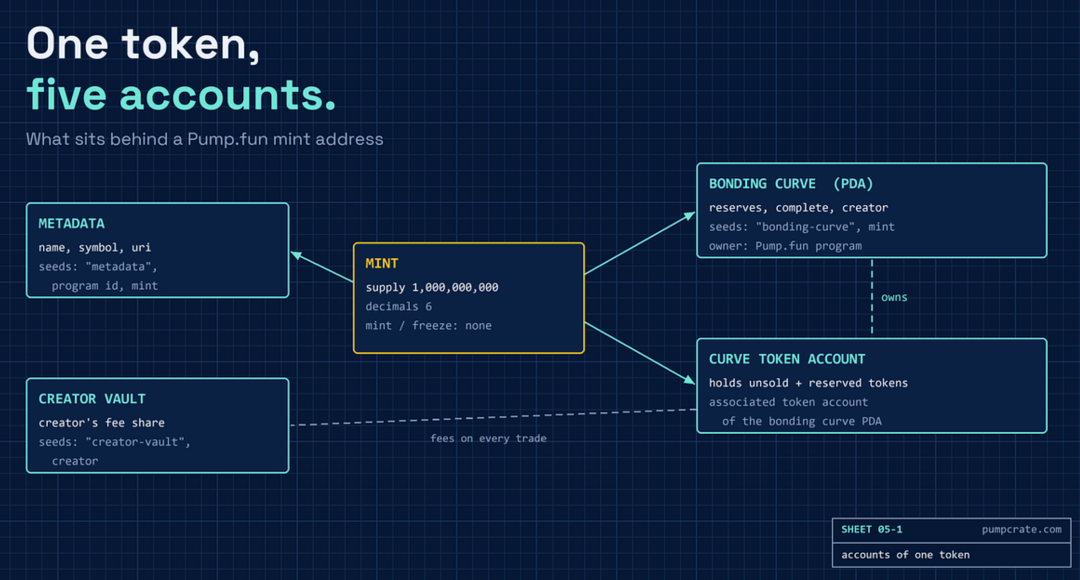
Before graduation: check the curve configuration
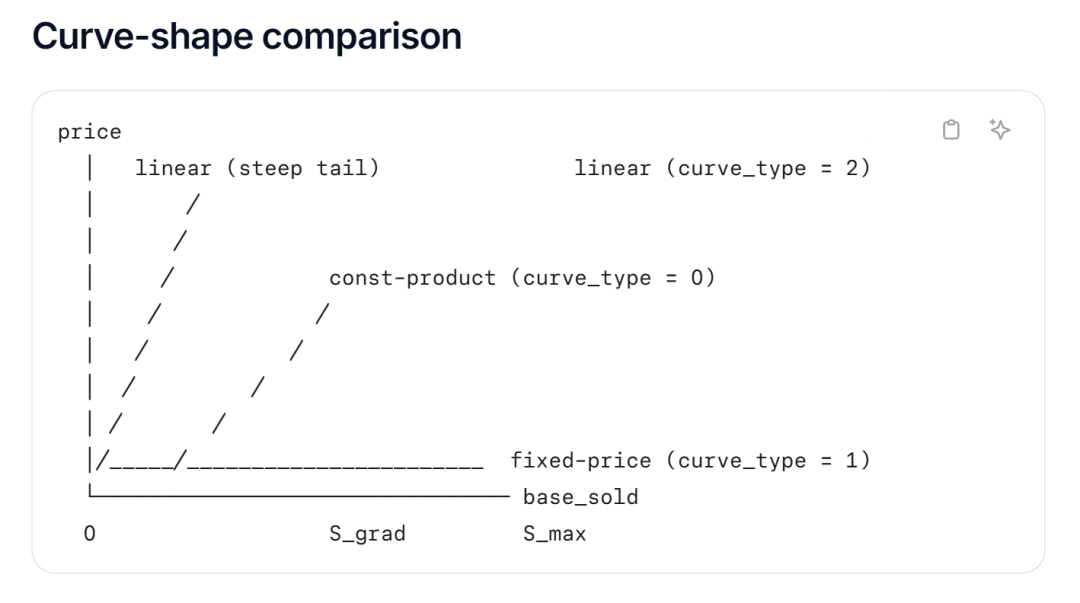
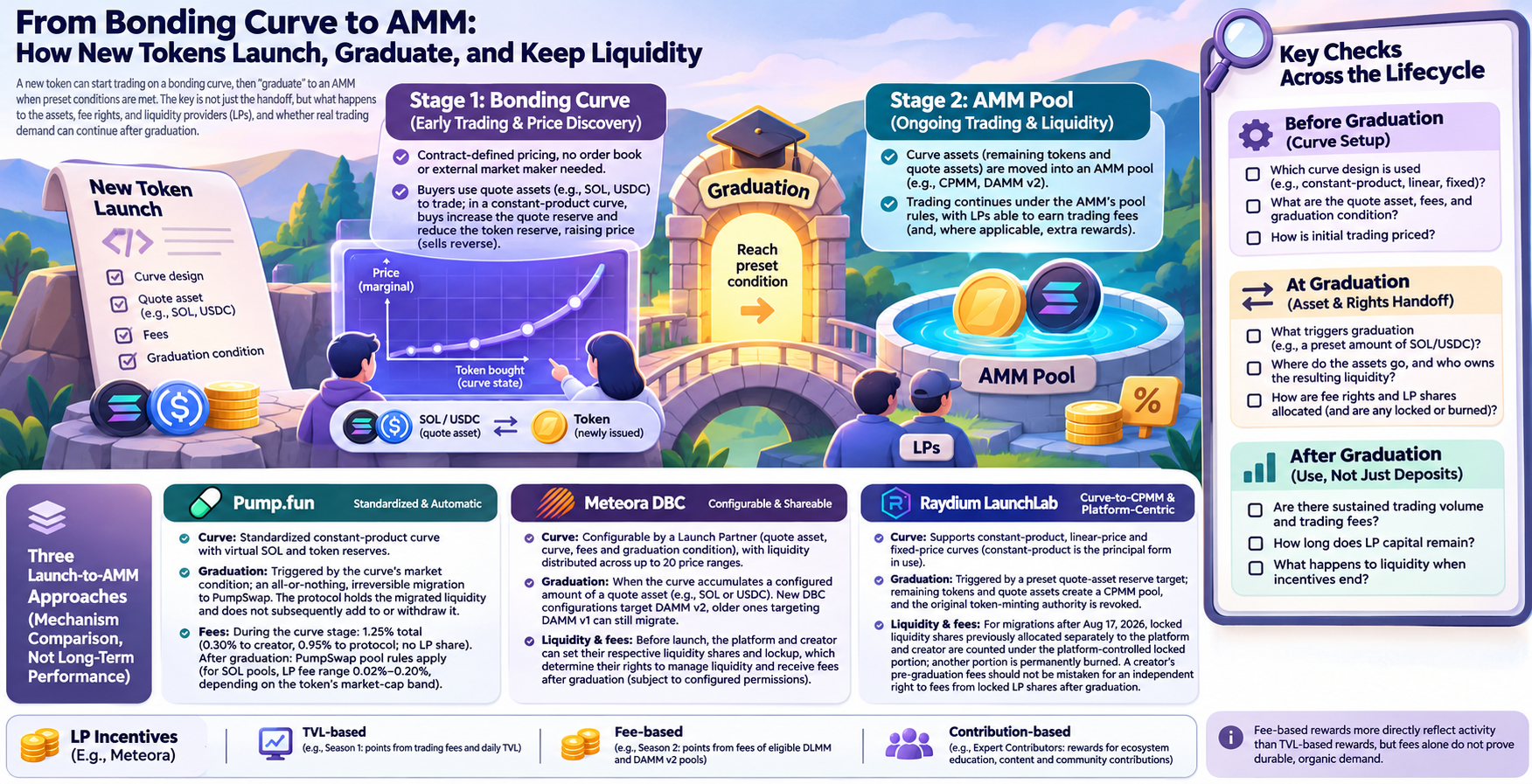
A bonding curve lets buyers and sellers trade against contract-defined pricing rather than waiting for an order book or an external market maker. In a constant-product curve, purchases increase the quote-asset reserve and reduce the token reserve, raising the marginal price; sales reverse that movement. Buyers still supply funds such as SOL or USDC. The curve reduces the issuer’s need to assemble an AMM pool in advance—it does not remove the need for capital.
The three approaches differ:
- Pump.fun uses a standardized constant-product curve with virtual SOL and token reserves for newly issued coins.
- Meteora DBC lets a Launch Partner configure the quote asset, curve, fees and graduation conditions. A curve can distribute liquidity across as many as 20 price ranges.
- Raydium LaunchLab supports constant-product, linear-price and fixed-price curve designs, although the analysis says constant-product is the principal form in use.
These settings explain how initial trades are priced. They do not, by themselves, establish demand for the token after graduation.
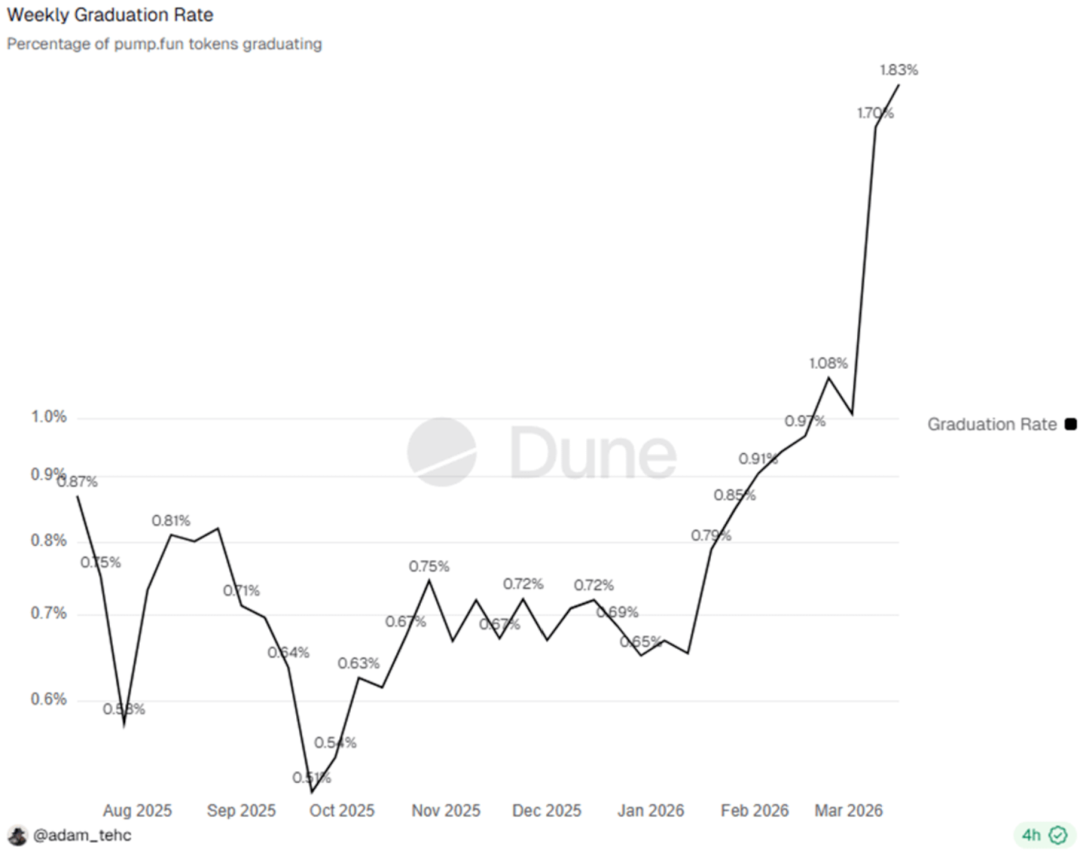
At graduation: check where liquidity and fee rights go
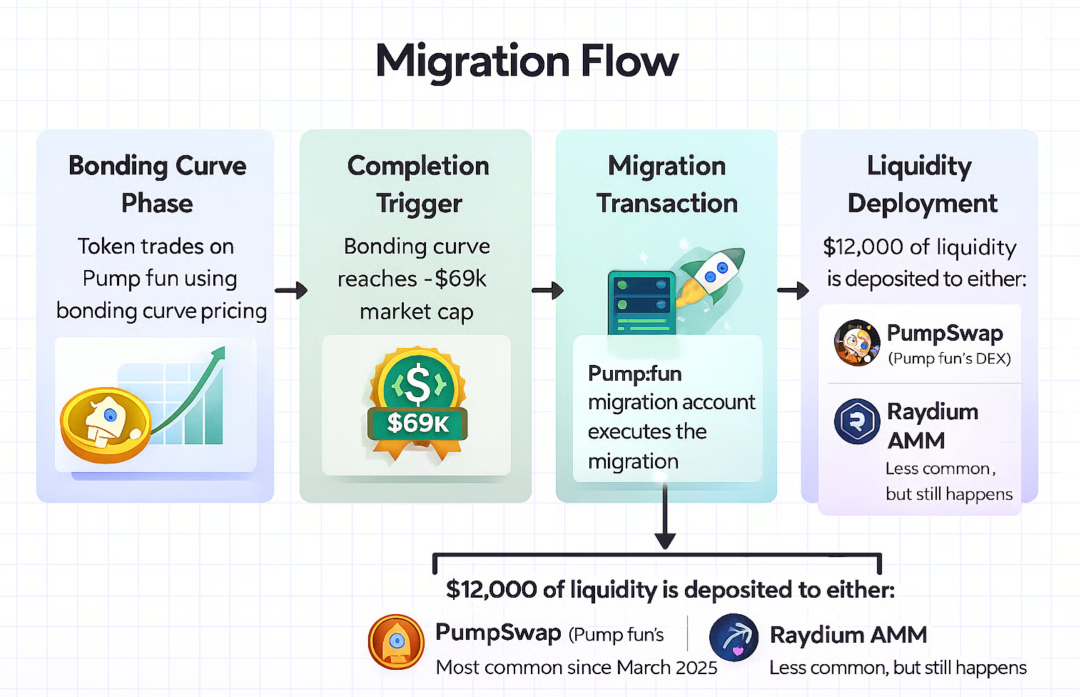
Graduation occurs when a curve reaches its specified condition and assets are moved into an AMM pool. The trigger and the ownership of resulting liquidity differ by protocol.
On Pump.fun, meeting the curve’s market condition closes the curve and moves liquidity to PumpSwap in an all-or-nothing, irreversible operation. The issuer does not need to create a separate pool. The analysis says the protocol holds the migrated liquidity and does not subsequently add to or withdraw that migrated portion. During the curve stage, the total trading fee is 1.25%: 0.30% goes to the token creator and 0.95% to the protocol, with no trading-fee allocation to LPs at that stage. After graduation, PumpSwap’s pool rules apply; for SOL-paired pools, the analysis gives an LP fee range of 0.02%–0.20%, depending on the token’s market-capitalization band.
For Meteora DBC, graduation is triggered when the curve accumulates a configured amount of a quote asset such as SOL or USDC. New DBC configurations target DAMM v2 after graduation; older configurations targeting DAMM v1 can still complete migration. Before launch, the platform and creator can specify their respective liquidity shares and how much is locked. Those shares determine their subsequent rights to manage liquidity and receive fees, subject to the configured permissions.
Raydium LaunchLab also uses a preset quote-asset reserve target. At graduation, remaining tokens and quote assets create a CPMM pool, and the original token-minting authority is revoked. According to the analysis, for migrations executed after August 17, 2026, locked liquidity shares previously allocated separately to the platform and creator are instead counted under the platform-controlled locked portion; another portion is permanently burned. A creator’s fees earned before graduation should therefore not be mistaken for an independent right to fees from locked LP shares after graduation.
After graduation: check use, not just deposits
An AMM pool makes continued trading possible, but its existence does not ensure trading volume or LP retention. LPs must weigh fees and any extra rewards against price exposure, impermanent loss, changing demand and the opportunity cost of their capital. Total value locked (TVL) shows how much capital is in pools; it does not show whether trading fees can support that capital after rewards end.
Meteora’s incentive changes illustrate the distinction. Its LP Stimulus Season 1 awarded 1,000 points per $1 of trading fees and one point per $1 of daily TVL. Season 2, which ran from July 1, 2025, to June 30, 2026, counted fees from eligible DLMM and DAMM v2 pools instead of TVL and allocated 20 million MET, approximately 2% of the MET supply. Standard eligible pools earned 1,000 points per $1 of fees, eligible DAMM v2 Beta activity earned 2,000, and Launch Pool activity earned 200.
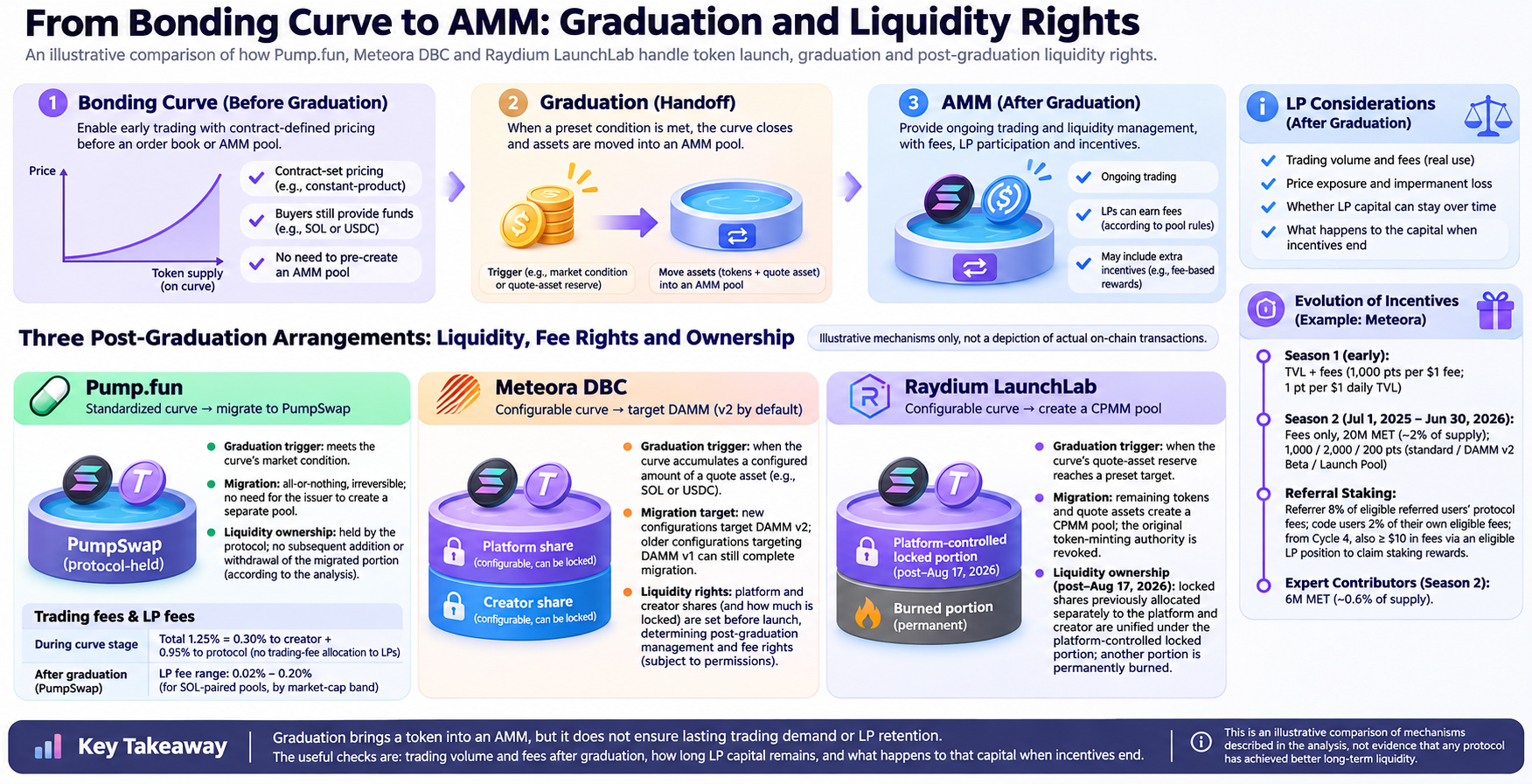
Meteora’s Referral Staking also links rewards to eligible DLMM use. The analysis says a MET staker can create a referral code; the referrer receives 8% of eligible referred users’ protocol fees, while code users receive 2% of the protocol fees generated by their own eligible liquidity positions. From Cycle 4, a staker must also generate at least $10 in fees through an eligible LP position opened during that cycle to claim its staking rewards. Separately, Season 2 allocated 6 million MET—about 0.6% of supply—to Expert Contributors.
Fee-based rewards more directly reflect activity than TVL-based rewards, but fees alone do not prove durable, organic demand. The analysis notes that comparable time-series data on post-graduation LP retention across the three protocols is lacking. To evaluate a launch-to-AMM design, the useful checks are trading volume and fees after graduation, how long LP capital remains, and what happens to that capital when incentives end.