Monero (XMR) rose 3.91% in 24 hours to $504.45 on Nov. 25, 2026, according to CoinGlass, bringing its market capitalization to about $9.5 billion. Bitcoin remained below $60,000 amid continued outflows from U.S. spot Bitcoin exchange-traded funds. Monero’s recovery coincided with progress on a proposed privacy upgrade, but the upgrade was not yet live.
What FCMP++ would change
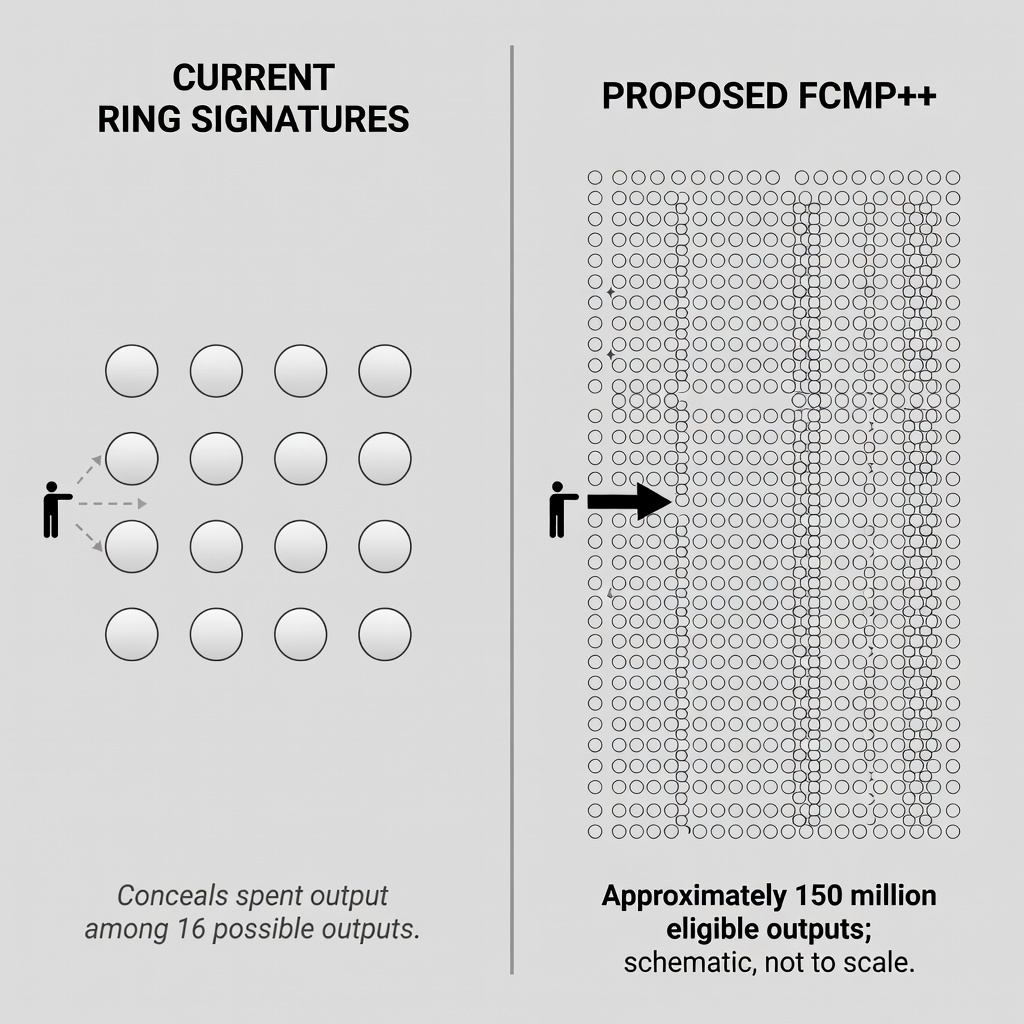
Monero’s ring signatures conceal which of 16 possible outputs a sender is spending. The proposed Full-Chain Membership Proofs (FCMP++) upgrade would let the sender prove ownership without identifying the output among roughly 150 million eligible outputs across the blockchain.
At a Nov. 23 developer meeting, Monero developer Justin Berman said security firm zkSecurity had begun the second phase of its audit of the FCMP++ integration. He said the third phase could begin the following week. No mainnet activation date had been announced.
An earlier audit found no high- or medium-severity vulnerabilities in the Generalized Bulletproofs implementation. That finding applied to one cryptographic component, not to the integration as a whole.
What the futures figures show
XMR futures open interest rose 1.45% in 24 hours to $231.57 million. The weighted funding rate was positive at 0.0087%, meaning traders holding long positions were paying those holding shorts. Short liquidations totaled about $39,590, less than the $54,680 in long liquidations. Those figures suggest forced buying to close short positions played only a limited role in the rebound.
The recovery followed a Nov. 20 exploit of XMR1, Wagyu’s wrapped Monero token. Reported losses were approximately $13.5 million, and XMR1 lost more than 99% of its value. The exploit did not compromise Monero’s native blockchain; native XMR traded near $480 in the aftermath.
Where the rebound stood on the daily chart
XMR held above its 200-day exponential moving average of $473.63. Its 14-day Relative Strength Index was near 43, suggesting selling pressure had eased, though the reading remained below the neutral level of 50. Trading volume was also below its recent average.
The chart analysis identified initial resistance at $519.22, followed by the 20-day and 50-day exponential moving averages at $525.43 and $543.07. A sustained move above both could bring $545.72 into view. On the downside, the analysis placed support at $492.11 and $485.72. A daily close below $485.72 could put the 200-day average back in reach, roughly 6% below the reported price.