Most soulbound-token designs attach a non-transferable credential to a wallet address. ERC-5114 takes a different approach: its badge identifies another NFT as its holder. In an explainer published on November 22, 2026, the source compares this design with three other soulbound-token proposals and examines what the distinction means for developers.
How the four designs differ
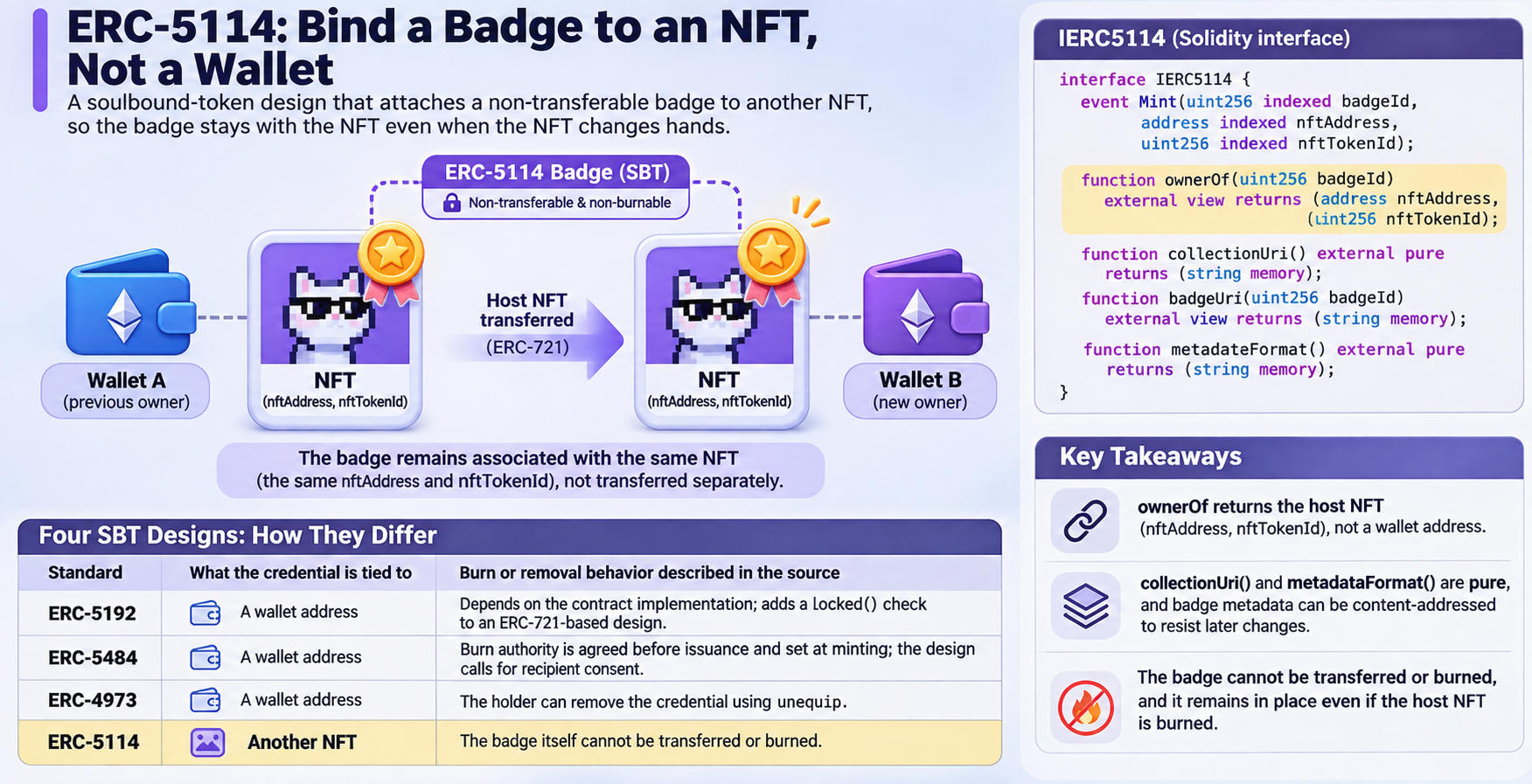
| Standard | What the credential is tied to | Burn or removal behavior described in the source |
|---|---|---|
| ERC-5192 | A wallet address | Depends on the contract implementation; adds a locked() check to an ERC-721-based design. |
| ERC-5484 | A wallet address | Burn authority is agreed before issuance and set at minting; the design calls for recipient consent. |
| ERC-4973 | A wallet address | The holder can remove the credential using unequip. |
| ERC-5114 | Another NFT | The badge itself cannot be transferred or burned. |
These are different approaches to non-transferability, not interchangeable settings on one SBT standard.
What to check in an ERC-5114 interface
The source illustrates ERC-5114 with this Solidity interface:
interface IERC5114 {
    event Mint(uint256 indexed badgeId, address indexed nftAddress, uint256 indexed nftTokenId);
    function ownerOf(uint256 badgeId) external view returns (address nftAddress, uint256 nftTokenId);
    function collectionUri() external pure returns (string memory);
    function badgeUri(uint256 badgeId) external view returns (string memory);
    function metadataFormat() external pure returns (string memory);
}
The key check is ownerOf: instead of returning a wallet address, it returns the host NFT’s contract address and token ID. If that NFT changes hands, the badge remains associated with the same NFT rather than being transferred separately. The source also describes the badge as remaining in place if the host NFT is burned.
The interface marks collectionUri() and metadataFormat() as pure, and the source describes content-addressed badge metadata as a way to resist later changes. Those design choices should not be read as a blanket guarantee that every implementation’s displayed content or surrounding system is immutable.
What non-transferability does not solve
A wallet-bound credential may still be handed over through control of the wallet itself. Public credentials can also expose sensitive information. The source discusses social recovery and zero-knowledge proofs as possible responses, but does not establish that either eliminates those risks. Likewise, using credentials for unsecured lending or Sybil-resistant distributions is presented as a potential application, not an outcome demonstrated by these interfaces.