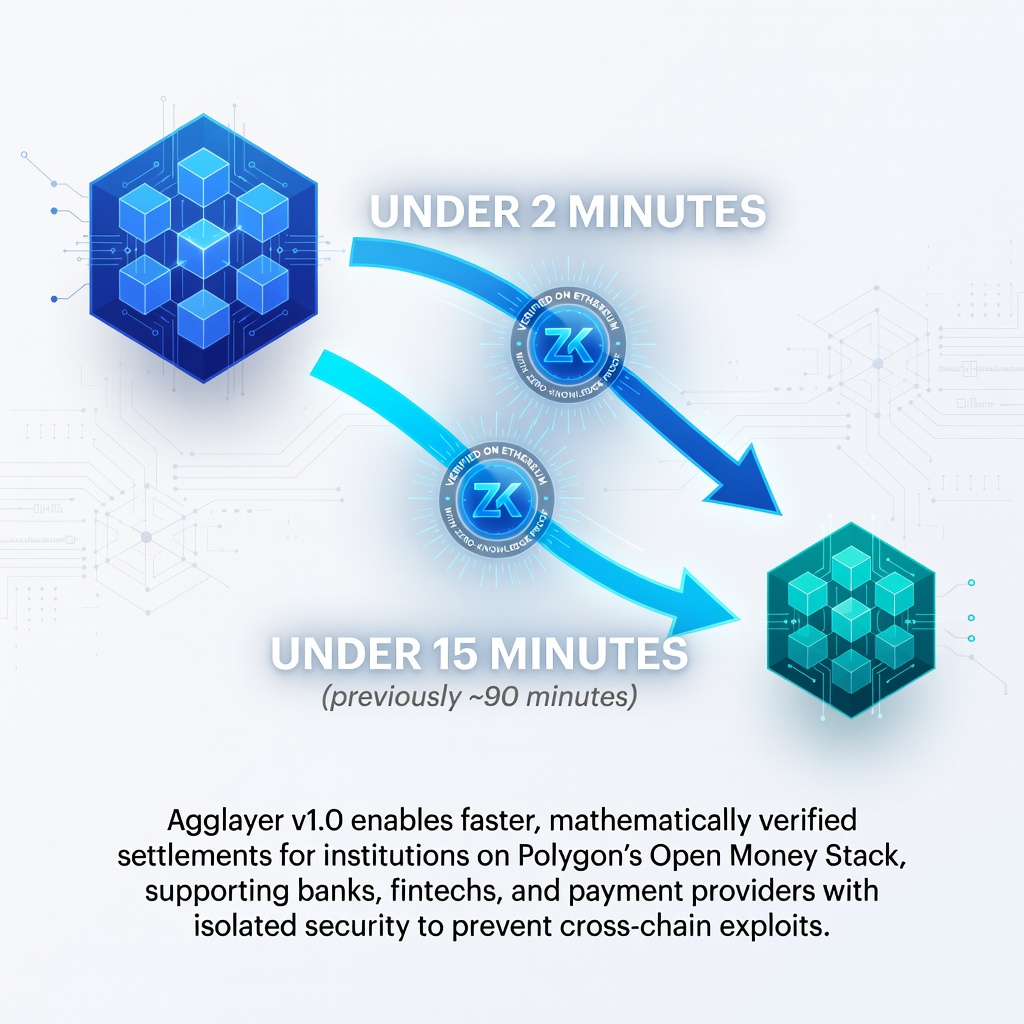
On November 23, 2026, Polygon Labs released Agglayer v1.0, an upgrade to its cross-chain settlement infrastructure. A November 23 announcement shared with crypto.news said verified transfers from Ethereum to connected networks can now finish in under two minutes, and transfers back to Ethereum in under 15 minutes.
What the release changes
Under v1.0, a transfer from Ethereum to a connected network such as Katana can complete in less than two minutes. The return path to Ethereum takes under 15 minutes, compared with roughly 90 minutes before. Each settlement is verified on Ethereum.
Polygon Labs said Agglayer has processed nearly $10 billion in settlements since it entered production in 2024. The company described v1.0 as the fastest zero-knowledge verified settlement infrastructure then operating in production. That “fastest” description is Polygon Labs’ characterization, not a third-party benchmark included in the announcement.
The stated purpose is faster cross-chain settlement for banks, fintech firms, and payment providers, without waiting for third-party bridge operators to approve transactions.
How a transfer is checked
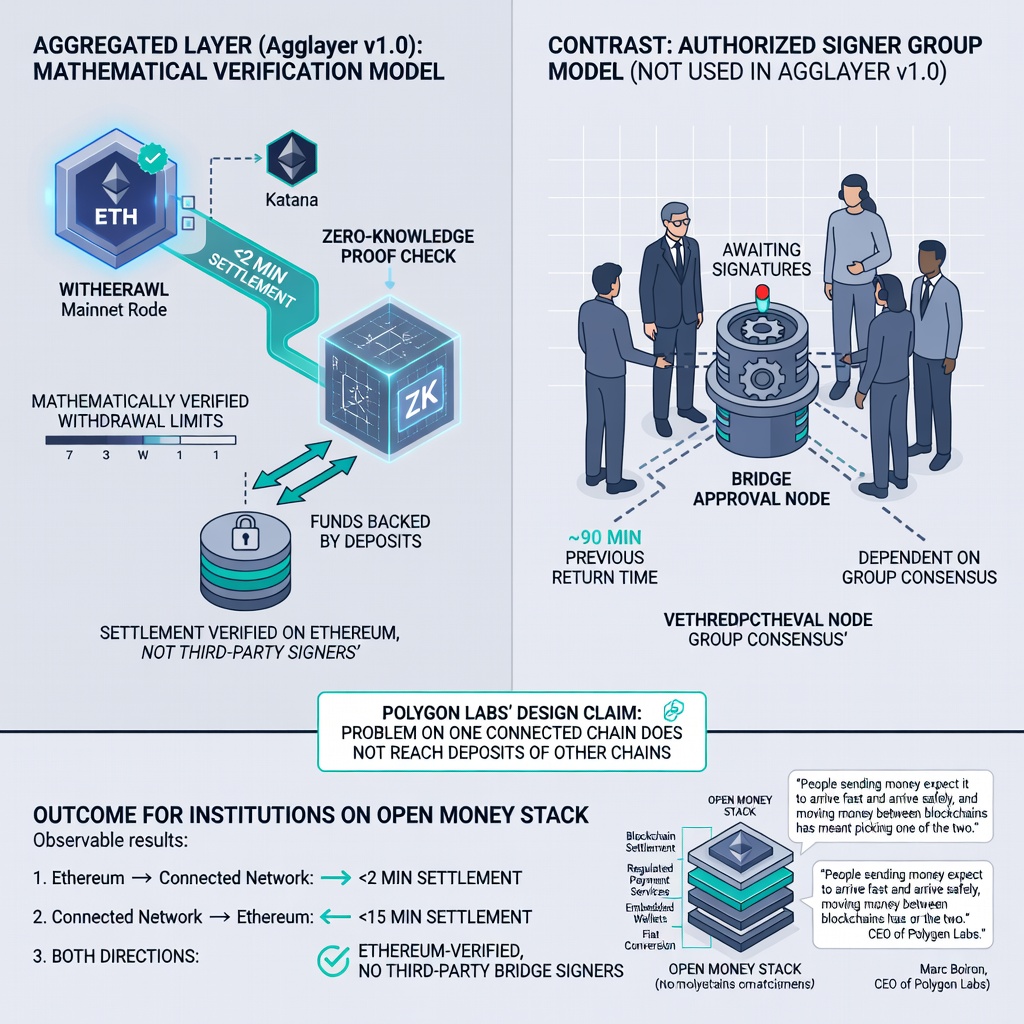
Agglayer uses zero-knowledge proofs verified on Ethereum. Those proofs are meant to show that funds withdrawn from a connected chain are backed by deposits. Unlike bridges that depend on a group of authorized signers, Agglayer uses mathematical checks to enforce withdrawal limits.
Polygon Labs says the design is meant to stop a compromised connected network from reaching deposits that belong to other connected chains. The company said this approach was already in place during a separate $292 million cross-chain exploit, and that Agglayer kept running without an incident that affected its own settlement infrastructure. That account is Polygon Labs’ statement; the announcement does not include a separate incident report.
Marc Boiron, CEO of Polygon Labs, said: “People sending money expect it to arrive fast and arrive safely, and moving money between blockchains has meant picking one of the two.” He said v1.0 provides the settlement speed and security the company considers necessary for stablecoin payments at banking scale.
Who it is for, and how to recognize the outcome
Agglayer v1.0 was made available immediately to institutions building payment and settlement services on Polygon’s Open Money Stack. That stack combines blockchain settlement with regulated payment services, embedded wallets, and fiat conversion. The announcement does not publish retail wallet steps, menu labels, or a public self-serve procedure.
For an institution already on that stack, the documented result is directional and observable in settlement time:
- Assets moving from Ethereum to a connected network settle in under two minutes.
- Assets moving back to Ethereum settle in under 15 minutes.
- Both directions are verified on Ethereum, rather than approved by third-party bridge signers.
Agglayer is the settlement layer. Other Open Money Stack components handle payment routing, wallets, and banking connections. Polygon Labs said the Open Money Stack had completed a SOC 2 Type 1 examination covering the design of relevant security controls. As described, that exam addresses control design, not a claim that the controls operated effectively over a review period.
Where it sits in the payments stack
In the months leading up to the November 23, 2026 announcement, Polygon expanded the same stack through deals and chain support. In October 2026 it completed the Coinme acquisition, which the company said secured access to 37 state money transmitter licenses and 11 exemptions covering 48 US states. Tazapay, Mesh, Toku, and Kira were named among businesses adopting the services.
After that acquisition, Polygon extended Open Money Stack to Solana so companies on Solana could use banking connections, digital wallets, and international payouts. Earlier in October 2026 it added TRON support for USDT deposits, cross-chain transfers, and fiat payouts through the same platform. The announcement does not give a separate calendar date for the Solana expansion.
Institutions can also attach chains they control. Banks can use Polygon CDK to build private blockchains with customized access rules and connect them to Agglayer. Networks on other technology stacks can join through compatible integrations. Polygon Labs said institutions can connect without paying protocol fees and can keep control of their own network operations.
Networks named as connected include Katana and OKX’s X Layer, with infrastructure support from Conduit, Gateway, and Succinct. Polygon had previously demonstrated interoperability with Miden, a privacy-focused blockchain, in a testnet environment. That Miden work was a testnet demonstration that Agglayer can support non-Ethereum architectures, not a production connection stated for this release.
What the release does not show
The announcement is evidence of a software change: shorter settlement windows, Ethereum-verified zero-knowledge checks, and immediate availability to Open Money Stack institutions. It does not report v1.0 adoption, retail usage instructions, or market effects. Speed figures, the production ranking, and the claim that a chain-level failure stays isolated should be read as Polygon Labs’ statements unless another source confirms them.