US spot Bitcoin ETFs recorded $5.7 billion in net outflows through November 25, already exceeding June’s full-month record of $4.51 billion. At the time of reporting on November 27, 2026, at 15:17:31 UTC+8, RootData put year-to-date net outflows at about $5.96 billion. Bitcoin had fallen below $60,000 again in November, reaching its lowest price since September 2024.
The flow figures establish how much money left the funds on balance, but not who withdrew it. Futures positions suggest that investors unwinding hedged trades could not explain all of November’s outflows. Disclosures identifying some of the sellers would not be available until February 2027.
What the holdings data can tell us
As of November 17, leveraged funds held a net short position of about 1,211 CME Bitcoin futures contracts, equivalent to roughly 6,000 BTC, according to CFTC positioning data. That was more than 90% below the December 2024 peak. The decline suggests that much of the basis trade—holding spot exposure while shorting futures—had unwound by early November. ETF outflows continued. In 10x Research’s view, the pattern was more consistent with investors steadily reducing their Bitcoin allocations.
Investment advisers and wealth platforms were the largest group of holders identified in third-quarter 13F filings, at about 40.5% of reported holdings. But the filings covered only 27.6% of the bitcoin in the funds. They do not establish that advisers led the selling, and the next disclosures will offer only a partial view.
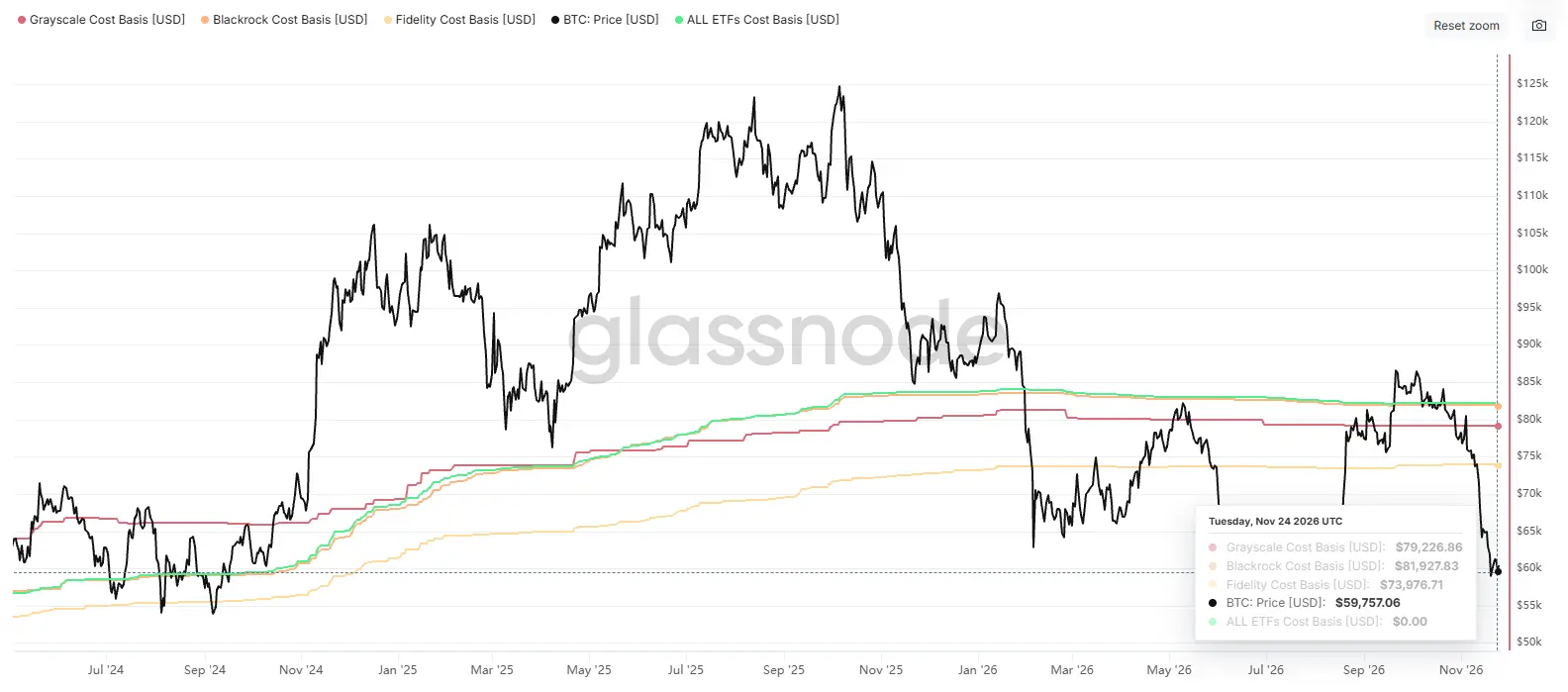
Glassnode’s cost estimates show what selling would have meant for an average holder. On November 24, bitcoin traded at about $59,757, versus estimated average costs of $81,928 for holders of BlackRock’s IBIT, $79,227 for Grayscale holders and $73,977 for Fidelity holders. For IBIT, that implied an average unrealized loss of about 27%, not a confirmed loss on shares sold.
Bitcoin fell with stocks but missed the rebound
The Federal Reserve raised rates in September for the first time in three years, the first rate-hiking cycle US spot Bitcoin ETFs had faced since launch. On October 28, the Fed held rates at 3.75%–4% without signaling a reversal. Bitcoin ETFs posted net outflows on 14 of the next 17 trading days, according to 10x Research.
On November 5, as AI stocks sold off, the Nasdaq 100 fell 6.36% and bitcoin lost about 5.5%. November 10 inflation data came in above expectations. After the Fed released its minutes on November 18, CME FedWatch put the probability of a December rate increase near 95%. Since October 28, however, bitcoin had fallen about 25%, compared with roughly 10% for the Nasdaq 100. Glassnode noted that US stocks had regained their election-day closing level while bitcoin turned lower again after the inflation release.
Crypto investors also faced risks distinct from those in equities. On the first trading day after the reported theft of about $6.3 billion from Binance, spot Bitcoin ETFs lost about $640 million, their largest daily net outflow since late June. ViaBTC chief analyst Jeff Ko attributed the outflow mainly to sentiment, noting that regulated institutions custody the ETFs’ bitcoin and that the funds had no direct connection to Binance. OneKey’s Yishi raised a separate custody question: Coinbase held most of IBIT’s roughly 760,000 BTC, Yishi said, while its $320 million insurance coverage amounted to less than 1% of IBIT’s holdings.
After Democrats won both chambers in the November 3 midterm elections, CertiK’s Stefan Muehlbauer judged the proposed CLARITY Act unlikely to pass in either the current or the next Congress. That was an assessment of the bill’s prospects, not a change in law.
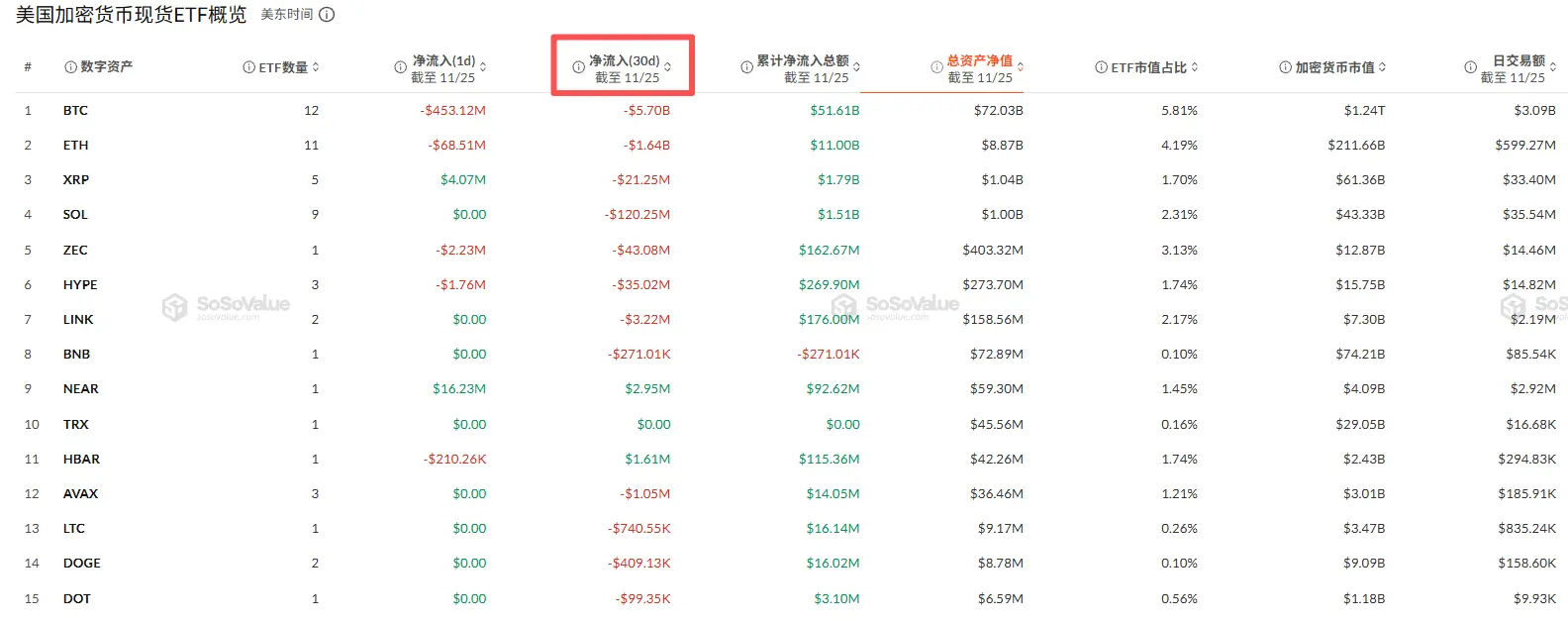
Outflows extended beyond bitcoin. In November 2025, newly listed SOL and XRP ETFs had attracted money while BTC and ETH funds saw withdrawals. In October 2026, SOL ETFs ended a 14-week run of net inflows. SoSoValue reported net outflows in 12 of 15 US spot crypto ETF categories over the latest 30 days, including $1.64 billion from Ether ETFs.
Treasury companies and miners were buying less or selling
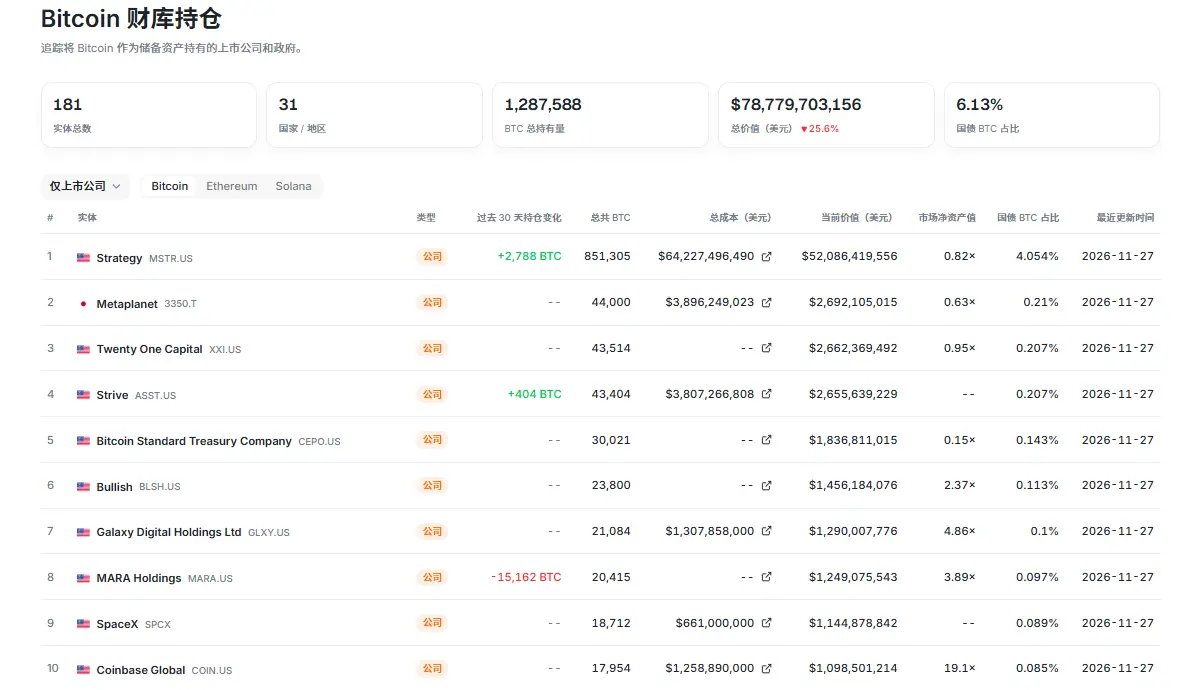
According to RootData, Strategy held 851,305 BTC at an average cost of about $75,000, implying an unrealized loss of roughly 20%. It added just 2,788 BTC over 30 days. Its shares traded below net asset value: the accompanying dashboard showed a market-to-net-asset-value multiple of 0.82×, while the reported figure was 0.83×. In late May, Strategy had sold 32 BTC to pay preferred dividends, its first bitcoin sale since December 2022.
On November 11, MSCI announced that it would remove Strategy from its indexes. The removals of Strategy, Metaplanet and Upexi were scheduled to take effect after the November 30 close. JPMorgan had estimated potential passive selling of about $2.8 billion. Strategy disputed the likely impact, saying the relevant funds held only about 3.1% of its shares. The estimate concerned index-related selling, not a confirmed sale of Strategy’s bitcoin.
Miner MARA said in its third-quarter shareholder letter that it sold 13,597 BTC after quarter-end for about $1.1 billion and planned further sales to fund projects including AI infrastructure. Over a separate 30-day measurement window, RootData recorded a 15,162 BTC decline in MARA’s holdings.
Stablecoin supply also contracted. According to rwa.xyz, total stablecoin market capitalization fell about $16 billion, or 5.58%, over 30 days to $273.09 billion. Coinkarma founder Benson Sun said that although he viewed longer-term indicators as favorable, both stablecoin and ETF 30-day net flows remained negative. He said he would wait for ETF flows to turn positive before buying.
What to watch at year-end
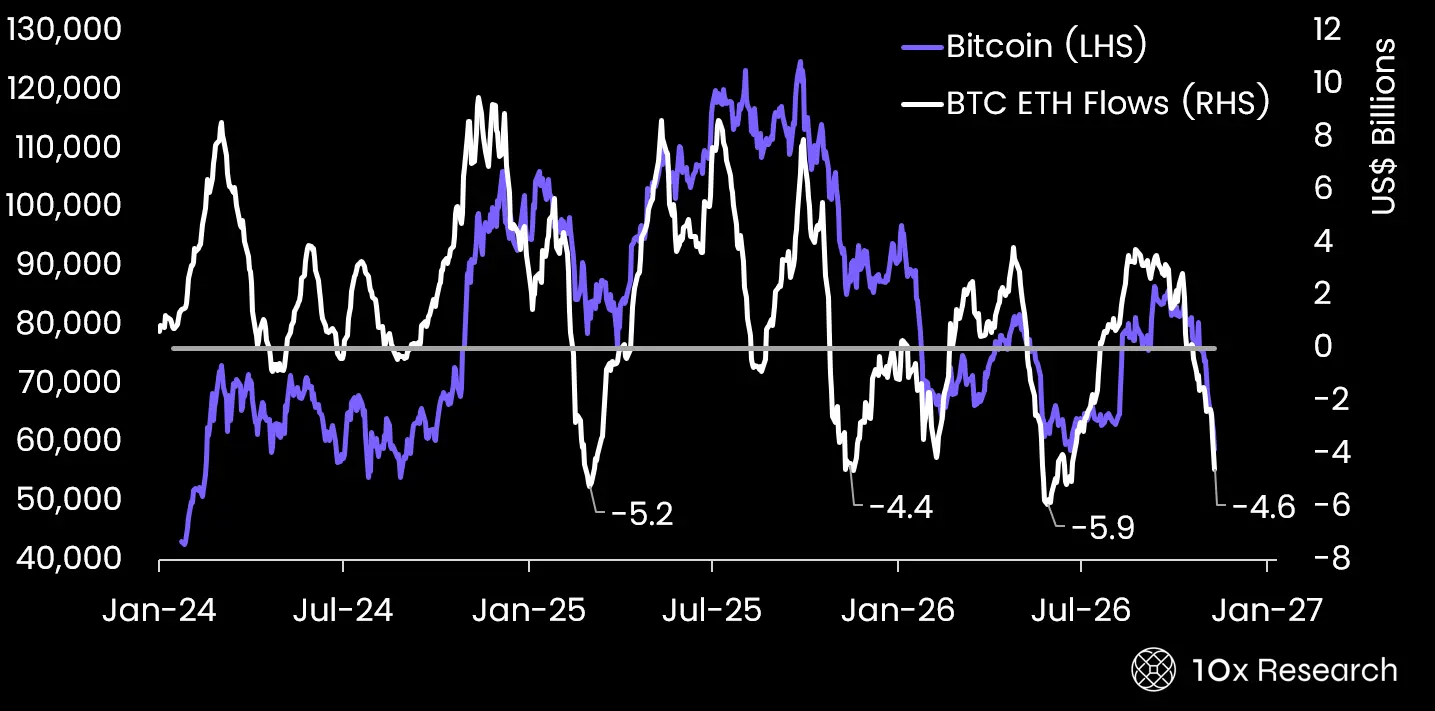
10x Research compared the latest rolling 30-day outflow of about $4.6 billion with three earlier episodes since early 2025 in which outflows reached $4 billion–$6 billion and bitcoin fell about $20,000. The written account described the flows as Bitcoin ETF flows, but the chart labels the series “BTC ETH Flows (RHS).” The $4.6 billion reading therefore cannot be verified from that chart as a Bitcoin-only figure. It is also a rolling 30-day measure, distinct from RootData’s $5.7 billion November-to-date total. Three earlier episodes are not enough to identify a price bottom.
After the scheduled November 30 index changes, the December Fed meeting would bring both a rate decision and guidance on the 2027 rate path. A quarter-point increase was widely expected, not yet decided.
December 31 also marked the year-end cutoff for realizing tax losses. Bitcoin ETFs had recorded about $1.1 billion in outflows over six consecutive days during Christmas week in 2025. For 2026, 10x Research estimated that about $14 billion in ETF positions carried unrealized losses—not that holders would sell $14 billion of shares. ETF shares were subject to wash-sale rules, while directly held bitcoin was not. Some investors could therefore sell ETF shares without leaving bitcoin altogether. Any tax-driven December selling, and any subsequent January inflow, remained possibilities rather than observed flows.