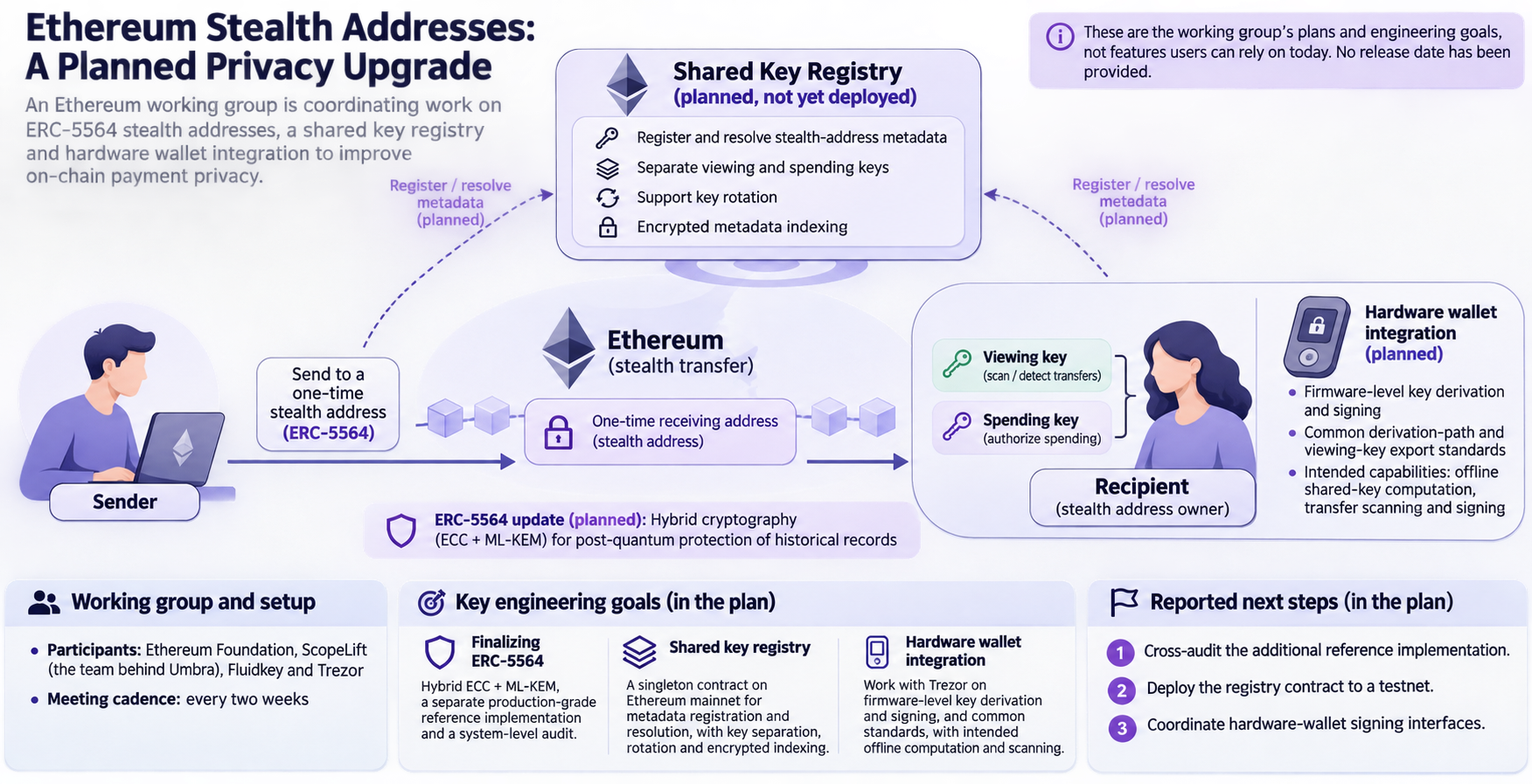
On November 18, 2026, Pierre, described as a member of the Ethereum Foundation’s privacy research effort, announced a working group focused on ERC-5564 stealth addresses and hardware wallet integration. The group’s stated plans are engineering goals, not features users can rely on today.
According to the working group information described in the report, participants include the Ethereum Foundation, ScopeLift—the team behind Umbra—Fluidkey and hardware wallet maker Trezor. The group plans to meet every two weeks.
What the group plans to build
- An ERC-5564 update: The group proposes combining existing elliptic-curve cryptography with lattice-based ML-KEM in a hybrid approach intended to protect historical transfer records against future quantum-computing attacks. It also plans a separate production-grade reference implementation and a system-level audit as part of the work toward finalizing the standard.
- A shared key registry: A proposed singleton contract on Ethereum mainnet would give compatible applications one interface for registering and resolving stealth-address metadata. The design aims to separate spending and viewing keys and support key rotation and encrypted metadata indexing, rather than requiring users to publish a stealth meta-address in each application.
- Hardware wallet support: The group plans to work with Trezor on firmware-level key derivation and signing, along with common derivation-path and viewing-key export standards. Offline shared-key computation, transfer scanning and signing are described as intended capabilities, not confirmed features of existing devices.
The reported next steps include cross-auditing the additional reference implementation, deploying the registry contract to a testnet, and coordinating hardware-wallet signing interfaces. The report does not provide a release date or a procedure for users to set up these proposed features.