At the Breakpoint conference in London, Solana Foundation AI lead Rishin Sharma outlined how the foundation wants AI agents to pay for online services using Solana. The remarks were reported on November 17, 2026; the figures and planned products below reflect that reporting, not a current status check.
What tools did Sharma describe?
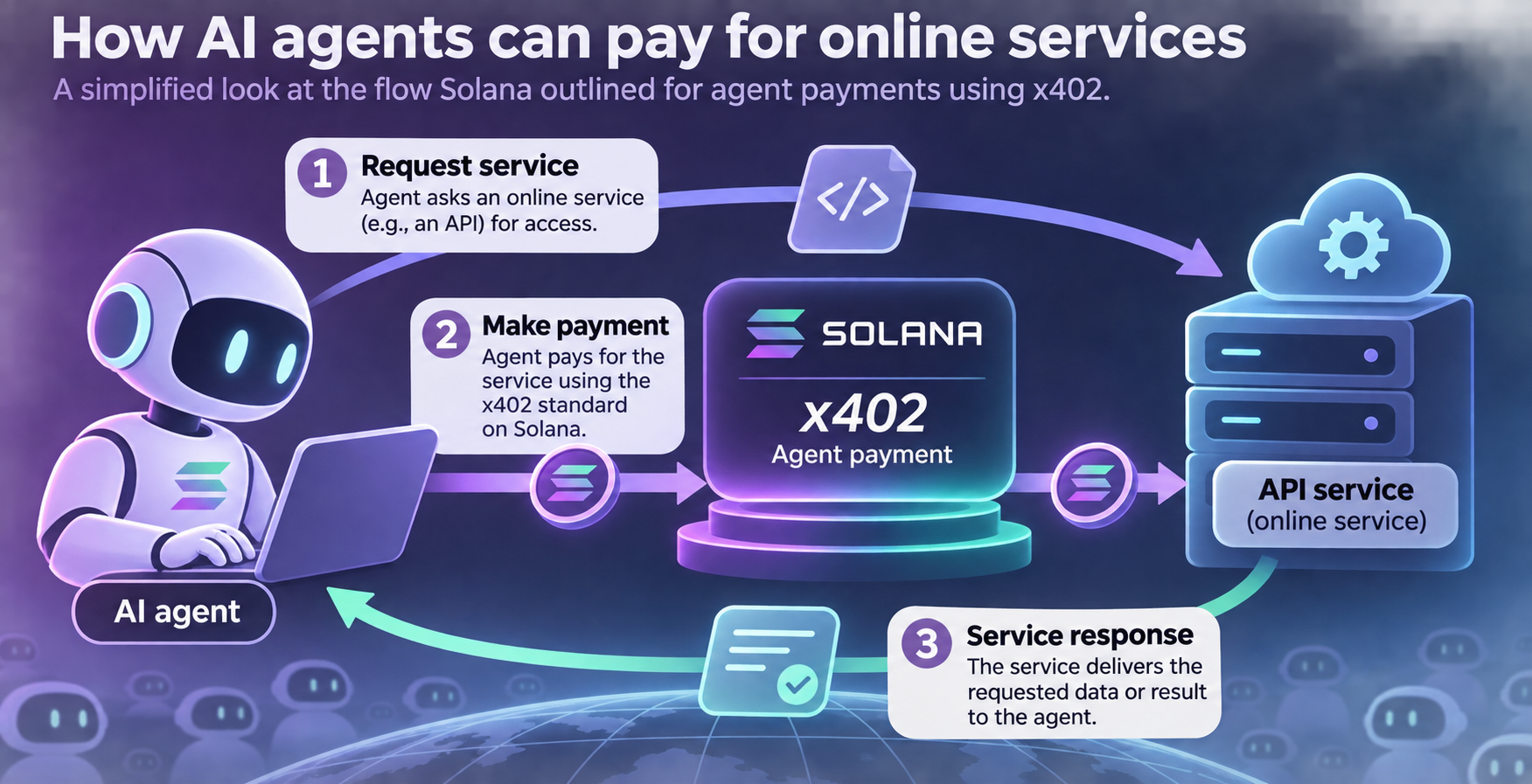
Sharma pointed to x402, a standard that lets AI agents pay for online services. He said it had processed more than 400 million payments totaling $100 million in volume, up from zero a year earlier. He also said Solana-based BlockRun had handled more than 60 million transactions in the preceding two months, describing it as the largest x402 server.
The foundation had launched payment channels that it said could handle 1 million payments per second, according to Sharma. He also described a private AI service offering attested private inference on Solana and Pay.sh, a server integrating more than 100 APIs that agents can pay to use. Those are descriptions of offerings and claimed capacity, not instructions for setting up an agent or independently verified performance results.
What was planned rather than available?
Sharma said the foundation was working with companies including Google, Alibaba and ByteDance to let them charge for AI models through agent payments. He said it planned to publish benchmarks of AI models on financial tasks and launch an on-ramp for users to convert cash into stablecoins for their AI assistants. He also showcased Solana.ai, a homepage for the network’s AI ecosystem that the foundation had launched the previous week, and said more than 120 teams were building AI products on Solana.
Sharma framed those efforts around growing automated activity. Citing Imperva, he said bots and other automated software accounted for more than 53% of global web traffic in 2025; that figure does not measure AI agents alone. OpenRouter’s monthly recap put the share of tokens processed through its marketplace using API keys classified as agentic at 76% in October 2026, up from 8% a year earlier.
Speaking earlier at the conference, Real Vision founder Raoul Pal offered a more cautious view: he argued that agents were not yet substantial economic actors, though he expected their use of blockchains to grow as more assets moved onchain.