In an article published on November 10, 2026, Liu Jiaolian reported that assets had been taken from thousands of Keplr social-login wallet accounts. Liu said Keplr had pointed to a vulnerability in Web3Auth infrastructure, but noted that the technical cause had not been fully disclosed and the providers disputed responsibility. The number of affected accounts and the cause should therefore be read as reported claims, not independently established findings.
The incident prompted Liu to compare four ways a wallet user might retain or recover access to a private key. The practical question is: what must remain secure for recovery to work without giving someone else access?
| Approach | Where access depends on trust | Main trade-off identified by Liu |
|---|---|---|
| Paper seed-phrase backup | The user keeps the phrase and protects the physical copy. | No recovery provider is needed, but a lost, damaged or exposed copy can put access at risk. |
| Uniswap Wallet cloud backup | According to Liu, an encrypted seed phrase is backed up to the user’s iCloud or Google Drive; recovery requires the cloud account and a separate encryption password. | The user must protect both the cloud account and that password. |
| MetaMask social login | Liu describes an encrypted seed phrase on MetaMask’s servers and a decryption key divided among server nodes. Recovery requires a Google, Apple or Telegram login and a user-set password. | Liu argues that if an attacker obtained the key fragments, they could try passwords offline, beyond the online recovery flow’s rate limits. |
| Keplr social-login scheme discussed by Liu | Liu describes three key shares—one on the device, one on a cloud server and one for recovery—with any two sufficient to reconstruct the key. | Liu suspects a weakness could arise if one provider effectively controls two shares. That is his hypothesis, not a confirmed explanation of the reported incident. |
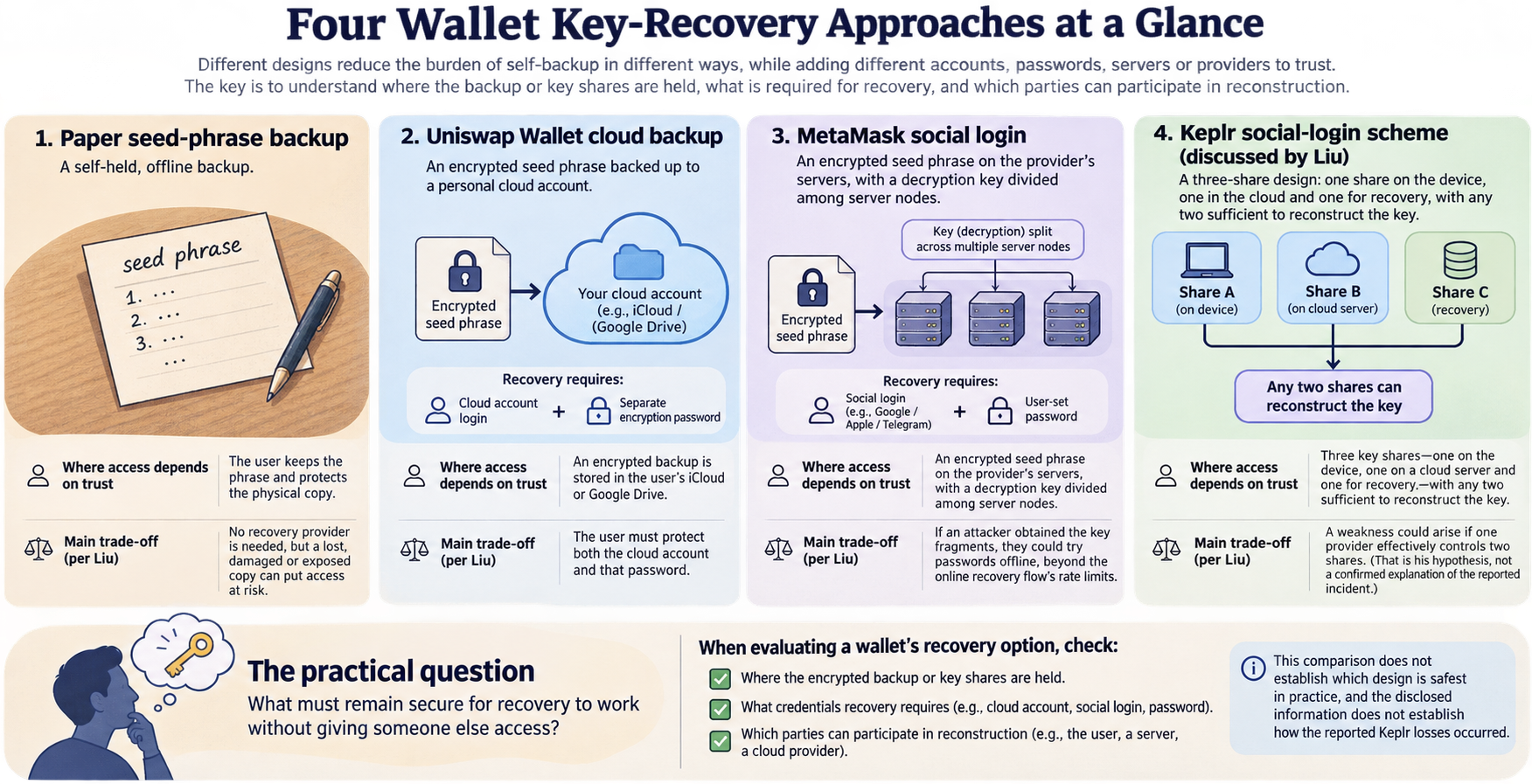
These designs address a real difficulty: a paper backup is straightforward to understand, but people can copy a phrase incorrectly or lose the paper. Recovery services can reduce that burden while adding accounts, passwords, servers or providers that users must rely on. Liu’s broader argument is that users should be able to understand those dependencies rather than treating a more elaborate recovery design as proof of greater security.
If you are evaluating a wallet’s recovery option, check where the encrypted backup or key shares are held, what credentials recovery requires, and which parties can participate in reconstruction. This comparison does not establish which design is safest in practice, and the disclosed information does not establish how the reported Keplr losses occurred.