As reported on November 11, 2026, Zodl was rolling out a new server architecture with its 3.20.0 wallet release. Its practical aim is to keep the service handling a Zcash wallet request from also seeing the user’s IP address. The protection is designed to work by default, without a manual setting, though Zodl said the rollout to users would take place in stages over the following days.
What changes when the wallet connects?
A mobile light wallet relies on remote services to retrieve blockchain data and broadcast transactions. A server receiving those requests can ordinarily see the connecting IP address, the request and its timing—even if the user’s ZEC is shielded on-chain.
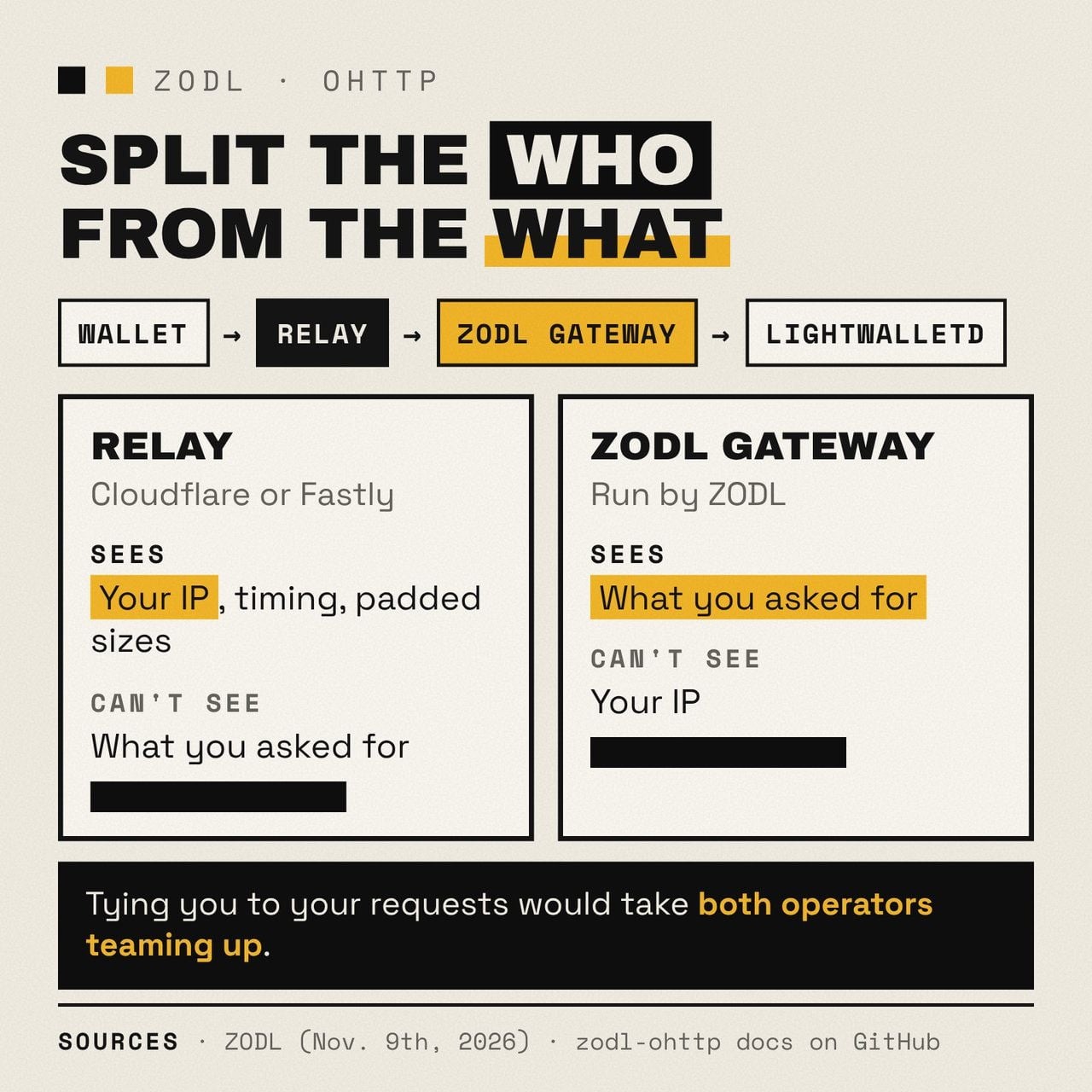
Zodl’s new design uses Oblivious HTTP (OHTTP) to split that information between two operators:
- The wallet encrypts its request so that only the Zodl gateway can open it.
- A relay operated by Cloudflare or Fastly receives the encrypted request and forwards it. The relay can see the user’s IP address, but not the request contents.
- The Zodl gateway decrypts the request and passes it to lightwalletd. It can see what was requested, but sees the relay’s address rather than the user’s IP.
The published code also includes request-size padding, intended to make traffic types harder to distinguish by packet size. According to the report, relay request IDs are recorded in Zodl’s logs as HMAC values calculated with a key held in gateway memory rather than as plaintext IDs. These are additional safeguards, not a guarantee against every form of traffic analysis.
What protection does—and doesn’t—follow?
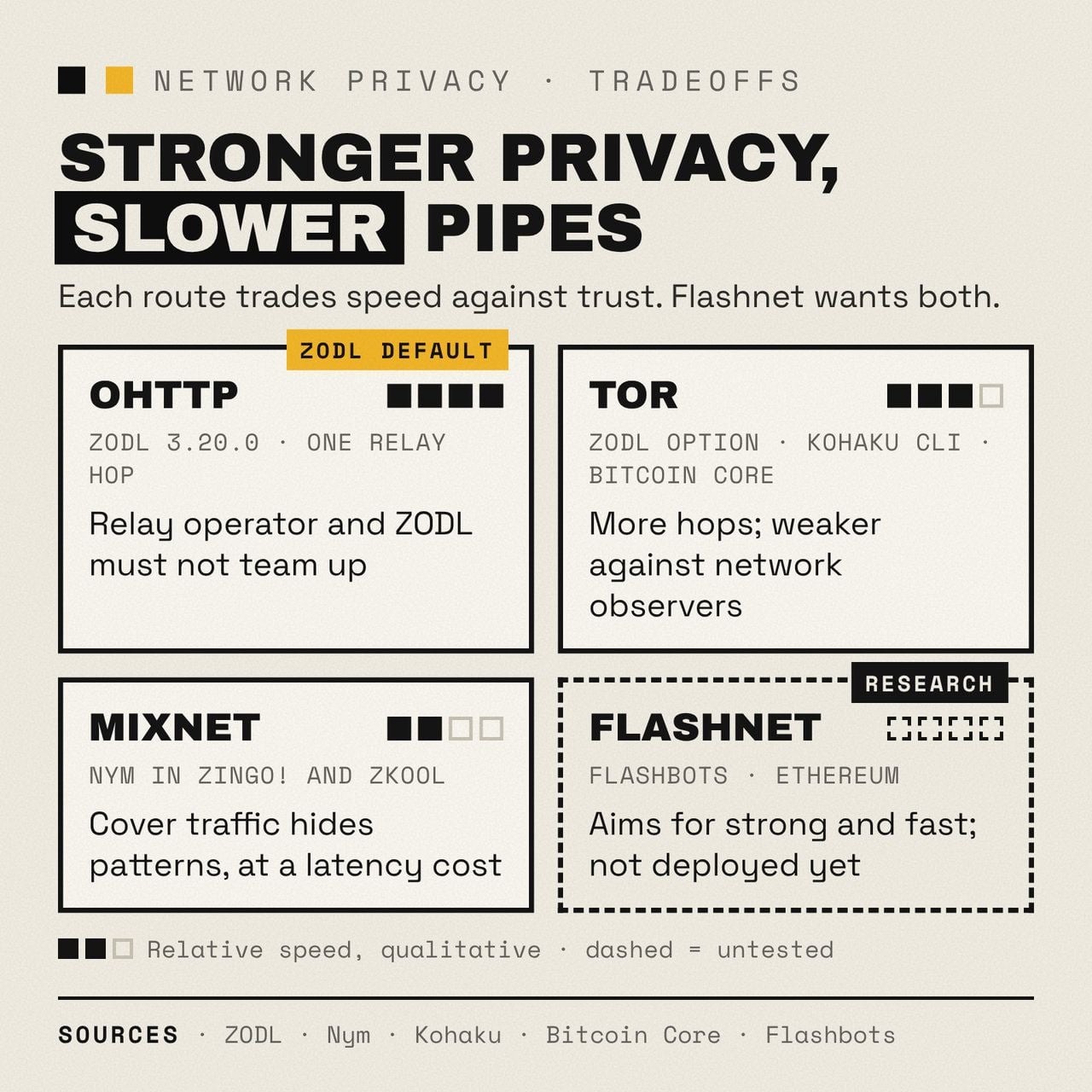
The separation depends on the relay operator and Zodl not colluding. A relay can still observe when a user connects and approximately how much traffic passes through it. Critics on a Zcash community forum also raised concerns about reliance on Cloudflare and Fastly, both US companies. Zodl core contributor y4ss acknowledged the limit, describing OHTTP as a better default rather than a replacement for Tor or Nym against a state-level adversary. For users whose threat model includes legal pressure on cloud providers, y4ss suggested enabling Zodl’s Tor option on top of OHTTP; the relay would then see a Tor exit IP instead of the user’s IP. The report says users can also switch to a community node in advanced settings.
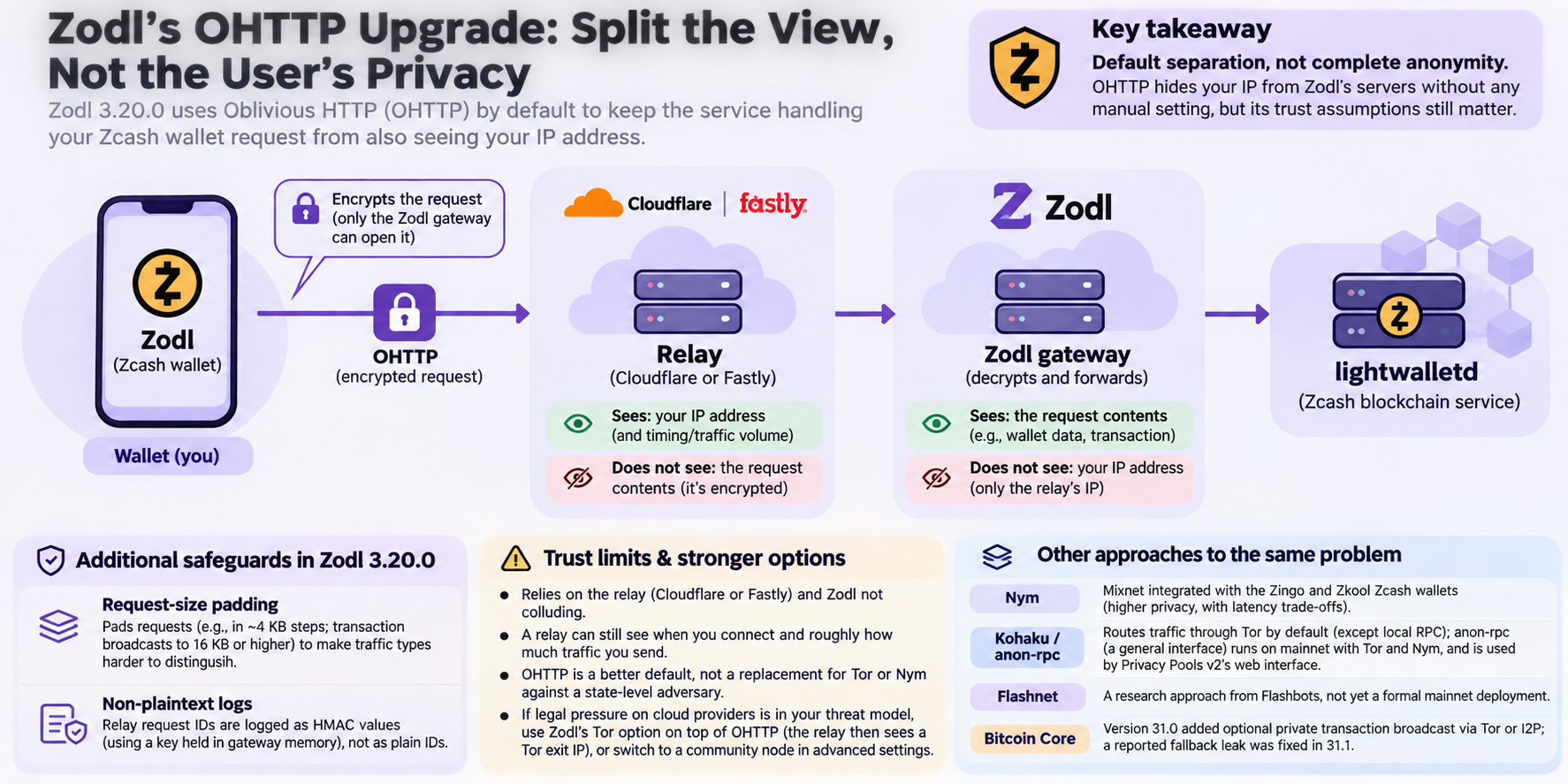
Other projects in the November 2026 report took different approaches to the same network-metadata problem. Nym said in September that its mixnet was integrated with the Zingo and Zkool Zcash wallets; mixnets add traffic-obscuring steps at a latency cost. The Ethereum Foundation’s Kohaku command-line tool routes traffic other than self-hosted local RPC calls through Tor by default. Its anon-rpc proposal sought a general interface for wallets to use anonymity networks; the report said a Tor- and Nym-supporting version was running on mainnet and used by Privacy Pools v2’s web interface. Flashbots’ Flashnet remained a research approach without a formal mainnet deployment or published benchmark figures. Bitcoin Core 31.0, released in April 2026, added an optional private transaction-broadcast feature using Tor or I2P; a reported fallback leak was fixed in version 31.1.
For Zodl users, the immediate distinction is default separation, not complete anonymity: once the 3.20.0 rollout reaches a wallet, OHTTP does not require the user to turn it on, but its stated trust assumptions still matter.